AT5G05410

UniProt ID: O82132
Organism: Arabidopsis thaliana
Review Status: IN PROGRESS
📝 Provide Detailed Feedback

Gene Description

DREB2A is a sequence-specific DNA-binding transcription factor that functions as a critical integrator of drought and heat stress responses through distinct transcriptional programs. The protein binds to DRE/CRT cis-regulatory elements (preferentially ACCGAC sequences) and activates stress-inducible genes including LEA proteins for drought tolerance and heat shock factors (HSFA3) for heat tolerance. DREB2A is post-translationally regulated through DRIP1/DRIP2-mediated ubiquitination and proteasomal degradation under normal conditions, but stabilizes during stress via CK1-mediated dephosphorylation of its negative regulatory domain.

Existing Annotations Review

GO Term Evidence Action Reason
GO:0005634 nucleus
IBA
GO_REF:0000033
ACCEPT
Summary: Nuclear localization is well-established for DREB2A through multiple experimental studies showing GFP-DREB2A fusion proteins accumulate in nucleus, particularly strongly during heat stress when protein is stabilized.
Reason: DREB2A contains two nuclear localization signals (NLS1, NLS2) and functions as a transcription factor in the nucleus where it accesses target gene promoters. Nuclear localization confirmed by IDA evidence in multiple publications.
Supporting Evidence:
PMID:16617101
Synthetic green fluorescent protein gave a strong signal in the nucleus under unstressed control conditions when fused to constitutive active DREB2A but only a weak signal when fused to full-length DREB2A. The region between DREB2A residues 136 and 165 plays a role in the stability of this protein in the nucleus, which is important for protein activation.
PMID:25490919
NF-YB3 and DPB3-1 form a trimer with NF-YA2 in the nucleus, and the trimer comprises a transcriptional complex with stabilized DREB2A
PMID:18552202
Jun 13. Arabidopsis DREB2A-interacting proteins function as RING E3 ligases and negatively regulate plant drought stress-responsive gene expression.
file:ARATH/AT5G05410/AT5G05410-deep-research-perplexity.md
provider: perplexity
GO:0006950 response to stress
IBA
GO_REF:0000033
MODIFY
Summary: This is an overly general term. DREB2A specifically responds to drought, heat, and osmotic stress, not all forms of stress. Should be replaced with more specific stress response terms.
Reason: While technically correct, this term is too broad and uninformative. DREB2A's core function is specifically in drought stress (response to water deprivation) and heat stress (response to heat), not general stress response.
Supporting Evidence:
AT5G05410-deep-research-perplexity.md
DREB2A occupies a central position in plant responses to multiple types of abiotic stress, functioning as a hub that integrates and coordinates distinct stress-signaling pathways. The most thoroughly characterized function of DREB2A is its role in conferring drought and salt stress tolerance through the activation of osmoprotective gene expression.
PMID:16617101
Apr 14. Functional analysis of an Arabidopsis transcription factor, DREB2A, involved in drought-responsive gene expression.
PMID:25490919
Dec 9. Arabidopsis DPB3-1, a DREB2A interactor, specifically enhances heat stress-induced gene expression by forming a heat stress-specific transcriptional complex with NF-Y subunits.
GO:0045893 positive regulation of DNA-templated transcription
IBA
GO_REF:0000033
ACCEPT
Summary: DREB2A functions as a transcriptional activator of stress-responsive genes through binding DRE/CRT elements. Well-supported by experimental evidence showing activation of target gene transcription.
Reason: DREB2A has a C-terminal transcriptional activation domain (aa 254-335) and activates expression of drought-inducible and heat-inducible genes. Multiple studies demonstrate transcriptional activation function.
Supporting Evidence:
PMID:16617101
DREB2A domain analysis using Arabidopsis protoplasts identified a transcriptional activation domain between residues 254 and 335
PMID:9707537
Both the DREB1A and DREB2A proteins specifically bound to the DRE sequence in vitro and activated the transcription of the b-glucuronidase reporter gene driven by the DRE sequence in Arabidopsis leaf protoplasts.
PMID:25490919
Dec 9. Arabidopsis DPB3-1, a DREB2A interactor, specifically enhances heat stress-induced gene expression by forming a heat stress-specific transcriptional complex with NF-Y subunits.
GO:0000976 transcription cis-regulatory region binding
IBA
GO_REF:0000033
MODIFY
Summary: DREB2A specifically binds to DRE/CRT cis-regulatory sequences in promoters of target genes. This is accurate but could be more specific.
Reason: While accurate, the more specific term "cis-regulatory region sequence-specific DNA binding" (GO:0000987) better captures DREB2A's sequence-specific binding to DRE elements with preference for ACCGAC motifs.
Supporting Evidence:
PMID:16617101
We found that the DREB2A protein could recognize not only A/GCCGACNT, but also A/GCCGACNA/G/C, and prefers ACCGAC to GCCGAC.
AT5G05410-deep-research-perplexity.md
DREB2A preferentially binds to ACCGAC sequences, whereas DREB1A has the highest affinity for A/GCCGACNT sequences. This difference in DNA-binding specificity has profound consequences, as it results in DREB2A and DREB1A regulating partially different sets of downstream genes.
PMID:9707537
Two transcription factors, DREB1 and DREB2, with an EREBP/AP2 DNA binding domain separate two cellular signal transduction pathways in drought- and low-temperature-responsive gene expression, respectively, in Arabidopsis.
GO:0003700 DNA-binding transcription factor activity
IBA
GO_REF:0000033
ACCEPT
Summary: This is the core molecular function of DREB2A. The protein binds DNA through its ERF/AP2 domain and activates transcription. Well-established through multiple studies.
Reason: DREB2A is a bona fide DNA-binding transcription factor with conserved ERF/AP2 DNA-binding domain (aa 68-133) and C-terminal activation domain. This annotation accurately represents the core molecular function.
Supporting Evidence:
PMID:9707537
Two cDNA clones that encode DRE binding proteins, DREB1A and DREB2A, were isolated by using the yeast one-hybrid screening technique
file:ARATH/AT5G05410/AT5G05410-uniprot.txt
DNA_BIND 78..135 AP2/ERF
PMID:16617101
Apr 14. Functional analysis of an Arabidopsis transcription factor, DREB2A, involved in drought-responsive gene expression.
GO:0003677 DNA binding
IEA
GO_REF:0000120
MODIFY
Summary: Too general. DREB2A has sequence-specific DNA-binding transcription factor activity, not just general DNA binding.
Reason: This IEA annotation is too broad. The more specific term "DNA-binding transcription factor activity" (GO:0003700) is more appropriate and already assigned based on IBA evidence.
Supporting Evidence:
AT5G05410-notes.md
Sequence-Specific Transcription Factor (CORE) - AP2/ERF family: Conserved ERF/AP2 DNA-binding domain (aa 68-133)
GO:0003700 DNA-binding transcription factor activity
IEA
GO_REF:0000002
ACCEPT
Summary: Duplicate of IBA annotation above. IEA evidence from InterPro domain prediction is consistent with experimental evidence.
Reason: This IEA annotation based on InterPro domain recognition is accurate and consistent with experimental IBA and IDA evidence for the same term. Computational annotation correctly identifies the core molecular function.
Supporting Evidence:
file:ARATH/AT5G05410/AT5G05410-uniprot.txt
InterPro IPR001471 AP2/ERF_dom
GO:0005634 nucleus
IEA
GO_REF:0000044
ACCEPT
Summary: Duplicate nuclear localization annotation. IEA from UniProtKB subcellular location annotation is consistent with experimental evidence.
Reason: This computational annotation based on UniProt subcellular location mapping is accurate and consistent with experimental IDA evidence. Correct prediction of nuclear localization.
Supporting Evidence:
file:ARATH/AT5G05410/AT5G05410-uniprot.txt
SUBCELLULAR LOCATION: Nucleus
GO:0006355 regulation of DNA-templated transcription
IEA
GO_REF:0000002
MODIFY
Summary: Too general. DREB2A specifically functions in positive regulation of transcription, not just regulation.
Reason: The more specific term "positive regulation of DNA-templated transcription" (GO:0045893) is already assigned with IBA evidence and better represents DREB2A's activator function rather than generic regulation.
Supporting Evidence:
AT5G05410-notes.md
Transcriptional activator: C-terminal activation domain (aa 254-335)
GO:0005515 protein binding
IPI
PMID:18552202
Arabidopsis DREB2A-interacting proteins function as RING E3 ...
MARK AS OVER ANNOTATED
Summary: This refers to interaction with DRIP1/DRIP2 E3 ubiquitin ligases. While technically correct, a more informative molecular function term should be used to describe DREB2A's function rather than just protein binding.
Reason: Generic protein binding annotations are uninformative. The DRIP1/DRIP2 interaction is important for DREB2A regulation but protein binding itself is not a molecular function we want to emphasize. Keep but mark as non-core.
Supporting Evidence:
PMID:18552202
Arabidopsis thaliana DREB2A-INTERACTING PROTEIN1 (DRIP1) and DRIP2
GO:0005515 protein binding
IPI
PMID:19548978
Unequally redundant RCD1 and SRO1 mediate stress and develop...
MARK AS OVER ANNOTATED
Summary: This refers to interaction with RCD1 (Radical-Induced Cell Death 1). Generic protein binding annotation is not informative.
Reason: Generic protein binding annotations are uninformative. The RCD1 interaction is important for regulation but protein binding itself is not a molecular function to emphasize. Keep but mark as non-core.
Supporting Evidence:
AT5G05410-notes.md
RCD1 (Radical-Induced Cell Death 1): Poly(ADP-ribose) polymerase (PARP) superfamily. Modulates DREB2A function during stress and senescence. Inhibitory interaction: Removed by alternative splicing (DREB2A.2)
PMID:19548978
2009 Jun 22. Unequally redundant RCD1 and SRO1 mediate stress and developmental responses and interact with transcription factors.
PMID:27881680
2016 Nov 23. Structures and Short Linear Motif of Disordered Transcription Factor Regions Provide Clues to the Interactome of the Cellular Hub Protein Radical-induced Cell Death1.
GO:0005515 protein binding
IPI
PMID:21536906
The Arabidopsis thaliana Med25 mediator subunit integrates e...
MARK AS OVER ANNOTATED
Summary: This refers to interaction with MED25 mediator subunit. Generic protein binding annotation is not informative.
Reason: Generic protein binding annotations are uninformative. The MED25 interaction may be important but protein binding itself is not a molecular function to emphasize. Keep but mark as non-core.
Supporting Evidence:
file:ARATH/AT5G05410/AT5G05410-uniprot.txt
Interacts with MED25
PMID:21536906
The Arabidopsis thaliana Med25 mediator subunit integrates environmental cues to control plant development.
GO:0005515 protein binding
IPI
PMID:32612234
Extensive signal integration by the phytohormone protein net...
MARK AS OVER ANNOTATED
Summary: Part of phytohormone protein interaction network study. Generic protein binding annotation is not informative about DREB2A's specific function.
Reason: Generic protein binding annotations are uninformative. Large-scale interaction studies often generate these annotations but they don't describe molecular function. Keep but mark as non-core.
Supporting Evidence:
GO_REF
Extensive signal integration by the phytohormone protein network - likely from large-scale interaction study
PMID:32612234
Jul 1. Extensive signal integration by the phytohormone protein network.
GO:0005515 protein binding
IPI
PMID:22447446
Interactions between DNA, transcriptional regulator Dreb2a a...
MARK AS OVER ANNOTATED
Summary: Structural study of DREB2A-Med25 interaction. Generic protein binding annotation is not informative.
Reason: Generic protein binding annotations are uninformative. While the Med25 interaction is structurally characterized, protein binding itself is not a molecular function to emphasize. Keep but mark as non-core.
Supporting Evidence:
PMID:22447446
Interactions between DNA, transcriptional regulator Dreb2a and the Med25 mediator subunit from Arabidopsis thaliana involve conformational changes
GO:0005515 protein binding
IPI
PMID:27881680
Structures and Short Linear Motif of Disordered Transcriptio...
MARK AS OVER ANNOTATED
Summary: Study on RCD1 interactions including DREB2A. Generic protein binding annotation is not informative.
Reason: Generic protein binding annotations are uninformative. The RCD1 interaction is biologically important for regulation but protein binding itself is not a molecular function to emphasize. Keep but mark as non-core.
Supporting Evidence:
PMID:27881680
Structures and Short Linear Motif of Disordered Transcription Factor Regions Provide Clues to the Interactome of the Cellular Hub Protein Radical-induced Cell Death1
GO:0005515 protein binding
IPI
PMID:25490919
Arabidopsis DPB3-1, a DREB2A interactor, specifically enhanc...
MARK AS OVER ANNOTATED
Summary: This refers to interaction with DPB3-1/NF-Y complex which is functionally important for heat stress-specific gene activation. Generic protein binding annotation is not informative.
Reason: Generic protein binding annotations are uninformative. While the DPB3-1 interaction is functionally critical for heat stress response, protein binding itself is not a molecular function to emphasize. Keep but mark as non-core.
Supporting Evidence:
PMID:25490919
We identified DNA POLYMERASE II SUBUNIT B3-1 (DPB3-1), which was previously annotated as NUCLEAR FACTOR Y, SUBUNIT C10 (NF-YC10), as a DREB2A interactor, through a yeast two-hybrid screen. The overexpression of DPB3-1 in Arabidopsis enhanced the expression of a subset of heat stress-inducible DREB2A target genes but did not affect dehydration-inducible genes.
GO:0005634 nucleus
IDA
PMID:25490919
Arabidopsis DPB3-1, a DREB2A interactor, specifically enhanc...
ACCEPT
Summary: Direct experimental evidence for nuclear localization during heat stress. Consistent with other nuclear localization annotations.
Reason: IDA evidence from GFP-DREB2A localization studies showing nuclear accumulation. This is a core cellular component annotation supported by direct experimental observation.
Supporting Evidence:
PMID:25490919
NF-YB3 and DPB3-1 form a trimer with NF-YA2 in the nucleus, and the trimer comprises a transcriptional complex with stabilized DREB2A
GO:0009408 response to heat
IDA
PMID:25490919
Arabidopsis DPB3-1, a DREB2A interactor, specifically enhanc...
ACCEPT
Summary: DREB2A is strongly induced by heat stress and critical for heat stress tolerance. Direct experimental evidence from heat stress experiments.
Reason: Heat stress response is a core biological process for DREB2A. The protein is stabilized during heat stress, activates heat shock factors (HSFA3) and HSPs, and DREB2A-CA overexpression improves thermotolerance. This is a primary function.
Supporting Evidence:
PMID:25490919
DEHYDRATION-RESPONSIVE ELEMENT BINDING PROTEIN2A (DREB2A) is a key transcription factor for drought and heat stress tolerance in Arabidopsis thaliana. DREB2A induces the expression of dehydration- and heat stress-inducible genes under the corresponding stress conditions.
AT5G05410-notes.md
Heat stress: Activates HSFA3 → Heat Shock Proteins cascade (DREB2A → HSFA3 → HSPs)
PMID:17030801
Dual function of an Arabidopsis transcription factor DREB2A in water-stress-responsive and heat-stress-responsive gene expression.
PMID:16617101
Apr 14. Functional analysis of an Arabidopsis transcription factor, DREB2A, involved in drought-responsive gene expression.
GO:0045893 positive regulation of DNA-templated transcription
IDA
PMID:25490919
Arabidopsis DPB3-1, a DREB2A interactor, specifically enhanc...
ACCEPT
Summary: Direct experimental evidence of transcriptional activation. Consistent with IBA annotation for the same term.
Reason: Multiple experimental studies demonstrate DREB2A functions as a transcriptional activator with acidic activation domain. IDA evidence supports this core molecular function.
Supporting Evidence:
PMID:25490919
DPB3-1 could form a transcriptional complex with NF-YA and NF-YB subunits and that the identified trimer enhances heat stress-inducible gene expression during heat stress responses in cooperation with DREB2A
GO:0000976 transcription cis-regulatory region binding
IPI
PMID:22037706
Enhanced Y1H assays for Arabidopsis.
MODIFY
Summary: Y1H assay demonstrating cis-regulatory region binding. Should be modified to more specific sequence-specific DNA binding term.
Reason: While accurate, the more specific term "cis-regulatory region sequence-specific DNA binding" (GO:0000987) better captures sequence-specific binding to DRE elements.
Supporting Evidence:
PMID:22037706
Enhanced Y1H assays for Arabidopsis
GO:0000976 transcription cis-regulatory region binding
IPI
PMID:25352272
Promoter-based integration in plant defense regulation.
MODIFY
Summary: Defense regulation study. Should be modified to more specific sequence-specific DNA binding term.
Reason: More specific term "cis-regulatory region sequence-specific DNA binding" (GO:0000987) is more appropriate for sequence-specific DRE binding.
Supporting Evidence:
PMID:25352272
Promoter-based integration in plant defense regulation
GO:0000976 transcription cis-regulatory region binding
IPI
PMID:25533953
An Arabidopsis gene regulatory network for secondary cell wa...
MODIFY
Summary: Secondary cell wall synthesis study. While from a non-core context, the molecular function is accurate but could be more specific.
Reason: The more specific term "cis-regulatory region sequence-specific DNA binding" (GO:0000987) better captures DREB2A's sequence-specific binding to DRE elements. This applies regardless of the biological context in which the annotation was derived.
Supporting Evidence:
PMID:25533953
An Arabidopsis gene regulatory network for secondary cell wall synthesis
GO:0000976 transcription cis-regulatory region binding
IPI
PMID:27650334
Transcriptional Regulation of Arabidopsis Polycomb Repressiv...
MODIFY
Summary: Polycomb repressive complex study. While from a non-core context, the molecular function is accurate but could be more specific.
Reason: The more specific term "cis-regulatory region sequence-specific DNA binding" (GO:0000987) better captures DREB2A's sequence-specific binding to DRE elements. This applies regardless of the biological context in which the annotation was derived.
Supporting Evidence:
PMID:27650334
Transcriptional Regulation of Arabidopsis Polycomb Repressive Complex 2 Coordinates Cell-Type Proliferation and Differentiation
GO:0000976 transcription cis-regulatory region binding
IPI
PMID:30356219
Transcriptional regulation of nitrogen-associated metabolism...
MODIFY
Summary: Nitrogen metabolism study. While from a non-core context, the molecular function is accurate but could be more specific.
Reason: The more specific term "cis-regulatory region sequence-specific DNA binding" (GO:0000987) better captures DREB2A's sequence-specific binding to DRE elements. This applies regardless of the biological context in which the annotation was derived.
Supporting Evidence:
PMID:30356219
Transcriptional regulation of nitrogen-associated metabolism and growth
GO:0000976 transcription cis-regulatory region binding
IPI
PMID:31806676
A PXY-Mediated Transcriptional Network Integrates Signaling ...
MODIFY
Summary: Vascular development study. While from a non-core context, the molecular function is accurate but could be more specific.
Reason: The more specific term "cis-regulatory region sequence-specific DNA binding" (GO:0000987) better captures DREB2A's sequence-specific binding to DRE elements. This applies regardless of the biological context in which the annotation was derived.
Supporting Evidence:
PMID:31806676
A PXY-Mediated Transcriptional Network Integrates Signaling Mechanisms to Control Vascular Development in Arabidopsis
GO:0071456 cellular response to hypoxia
HEP
PMID:31519798
Integrative Analysis from the Epigenome to Translatome Uncov...
KEEP AS NON CORE
Summary: High-throughput expression profiling study. Hypoxia response may be a peripheral function or indirect effect rather than core DREB2A function.
Reason: While DREB2A may be induced during hypoxia, this is not a well-established core function compared to drought and heat stress. HEP evidence from high-throughput study is weaker than direct functional studies. Keep but mark as non-core.
Supporting Evidence:
PMID:31519798
Integrative Analysis from the Epigenome to Translatome Uncovers Patterns of Dominant Nuclear Regulation during Transient Stress
GO:0005634 nucleus
ISM
GO_REF:0000122
ACCEPT
Summary: Computational prediction from AtSubP subcellular localization prediction. Consistent with experimental evidence.
Reason: Computational prediction correctly identifies nuclear localization. Consistent with multiple IDA annotations and well-established experimental evidence.
Supporting Evidence:
GO_REF:0000122
AtSubP analysis - automated subcellular localization prediction for Arabidopsis
GO:0005634 nucleus
IDA
PMID:21443605
A subcellular localization compendium of hydrogen peroxide-i...
ACCEPT
Summary: Direct experimental evidence for nuclear localization. Consistent with other annotations.
Reason: Direct experimental observation of nuclear localization. This is a well-established cellular component annotation.
Supporting Evidence:
PMID:21443605
A subcellular localization compendium of hydrogen peroxide-induced proteins
GO:0005634 nucleus
IDA
PMID:18552202
Arabidopsis DREB2A-interacting proteins function as RING E3 ...
ACCEPT
Summary: Direct experimental evidence for nuclear localization from DRIP1/DRIP2 interaction study. Consistent with other annotations.
Reason: Direct experimental observation of nuclear localization. DRIP1/DRIP2 interact with DREB2A in the nucleus for ubiquitination and degradation.
Supporting Evidence:
PMID:18552202
Arabidopsis DREB2A-interacting proteins function as RING E3 ligases and negatively regulate plant drought stress-responsive gene expression
GO:0010224 response to UV-B
IEP
PMID:18266923
Identification of a novel cis-regulatory element for UV-B-in...
KEEP AS NON CORE
Summary: Expression profiling shows DREB2A is induced by UV-B. This may be a peripheral stress response rather than core function.
Reason: While DREB2A expression responds to UV-B stress, this is not a well-characterized core function compared to drought and heat stress. UV-B response may be pleiotropic or indirect. Keep but mark as non-core.
Supporting Evidence:
PMID:18266923
Identification of a novel cis-regulatory element for UV-B-induced transcription in Arabidopsis
GO:0010224 response to UV-B
IGI
PMID:14739338
Genome-wide analysis of gene expression reveals function of ...
KEEP AS NON CORE
Summary: Genetic interaction evidence in HY5 UV-B response pathway. This may be a peripheral function.
Reason: While there is genetic evidence for DREB2A involvement in UV-B response, this is not a core function. The annotation may reflect crosstalk between stress pathways rather than primary UV-B function. Keep but mark as non-core.
Supporting Evidence:
PMID:14739338
Genome-wide analysis of gene expression reveals function of the bZIP transcription factor HY5 in the UV-B response of Arabidopsis
GO:0010286 heat acclimation
IEP
PMID:16807682
Gene expression profiles during heat acclimation in Arabidop...
ACCEPT
Summary: Expression profiling during heat acclimation. Heat acclimation is more specific than general heat response.
Reason: Heat acclimation (acquired thermotolerance) is a well-established function of DREB2A. The protein is induced during heat stress and DREB2A-CA overexpression improves thermotolerance. This represents the adaptive heat stress response.
Supporting Evidence:
PMID:16807682
Gene expression profiles during heat acclimation in Arabidopsis thaliana suspension-culture cells
AT5G05410-deep-research-perplexity.md
Transgenic Arabidopsis overexpressing DREB2A-CA showed significantly increased thermotolerance, surviving exposure to temperatures that killed wild-type plants, and conversely, dreb2a mutant plants displayed reduced basal thermotolerance
PMID:25490919
Dec 9. Arabidopsis DPB3-1, a DREB2A interactor, specifically enhances heat stress-induced gene expression by forming a heat stress-specific transcriptional complex with NF-Y subunits.
PMID:17030801
Dual function of an Arabidopsis transcription factor DREB2A in water-stress-responsive and heat-stress-responsive gene expression.
GO:0042542 response to hydrogen peroxide
IEP
PMID:17030801
Dual function of an Arabidopsis transcription factor DREB2A ...
KEEP AS NON CORE
Summary: Expression induced by hydrogen peroxide treatment. This may be a secondary oxidative stress response rather than core function.
Reason: While DREB2A expression responds to hydrogen peroxide (oxidative stress), this is likely a peripheral response. Drought and heat stress can generate ROS, so this may be indirect. Keep but mark as non-core.
Supporting Evidence:
PMID:17030801
Dual function of an Arabidopsis transcription factor DREB2A in water-stress-responsive and heat-stress-responsive gene expression
GO:0009408 response to heat
IMP
PMID:17030801
Dual function of an Arabidopsis transcription factor DREB2A ...
ACCEPT
Summary: Mutant phenotype evidence demonstrating DREB2A is required for heat stress response. This is a core biological process.
Reason: Heat stress response is a primary core function of DREB2A demonstrated by multiple lines of evidence including mutant phenotypes, overexpression studies, and target gene analysis. This is essential biology.
Supporting Evidence:
PMID:17030801
Dual function of an Arabidopsis transcription factor DREB2A in water-stress-responsive and heat-stress-responsive gene expression
AT5G05410-notes.md
Heat stress: Activates HSFA3 → Heat Shock Proteins cascade (DREB2A → HSFA3 → HSPs). CRITICAL: DREB2A → HSFA3 → Heat Shock Proteins cascade
PMID:25490919
Dec 9. Arabidopsis DPB3-1, a DREB2A interactor, specifically enhances heat stress-induced gene expression by forming a heat stress-specific transcriptional complex with NF-Y subunits.
PMID:16617101
Apr 14. Functional analysis of an Arabidopsis transcription factor, DREB2A, involved in drought-responsive gene expression.
GO:0003700 DNA-binding transcription factor activity
IDA
PMID:9707537
Two transcription factors, DREB1 and DREB2, with an EREBP/AP...
ACCEPT
Summary: Original paper demonstrating DREB2A binds DRE sequences and activates transcription. This is the foundational evidence for DREB2A's core molecular function.
Reason: This is the original experimental demonstration of DREB2A's DNA-binding transcription factor activity using yeast one-hybrid screening and transactivation assays. Core molecular function.
Supporting Evidence:
PMID:9707537
Both the DREB1A and DREB2A proteins specifically bound to the DRE sequence in vitro and activated the transcription of the b-glucuronidase reporter gene driven by the DRE sequence in Arabidopsis leaf protoplasts
GO:0005634 nucleus
IDA
PMID:16617101
Functional analysis of an Arabidopsis transcription factor, ...
ACCEPT
Summary: Direct GFP-DREB2A localization experiments showing nuclear accumulation. Core cellular component annotation.
Reason: Direct experimental observation using GFP fusion proteins. Well-established nuclear localization with functional significance for transcriptional activity.
Supporting Evidence:
PMID:16617101
Synthetic green fluorescent protein gave a strong signal in the nucleus under unstressed control conditions when fused to constitutive active DREB2A but only a weak signal when fused to full-length DREB2A.
GO:0009414 response to water deprivation
IMP
PMID:16617101
Functional analysis of an Arabidopsis transcription factor, ...
ACCEPT
Summary: Mutant phenotype and overexpression evidence demonstrating DREB2A is required for drought tolerance. This is a core biological process.
Reason: Response to water deprivation (drought stress) is a primary core function of DREB2A. The name "Dehydration-Responsive Element Binding Protein" reflects this primary function. Multiple studies demonstrate necessity and sufficiency for drought tolerance.
Supporting Evidence:
PMID:16617101
Overexpression of constitutive active DREB2A resulted in significant drought stress tolerance but only slight freezing tolerance in transgenic Arabidopsis plants
AT5G05410-notes.md
Drought stress: Activates LEA proteins, osmoprotective genes for osmotic adjustment
PMID:9707537
Two transcription factors, DREB1 and DREB2, with an EREBP/AP2 DNA binding domain separate two cellular signal transduction pathways in drought- and low-temperature-responsive gene expression, respectively, in Arabidopsis.
PMID:10809011
Organization and expression of two Arabidopsis DREB2 genes encoding DRE-binding proteins involved in dehydration- and high-salinity-responsive gene expression.
GO:0003700 DNA-binding transcription factor activity
ISS
PMID:11118137
Arabidopsis transcription factors: genome-wide comparative a...
ACCEPT
Summary: Sequence similarity inference from genome-wide transcription factor analysis. Consistent with experimental evidence.
Reason: Computational inference based on sequence similarity to known transcription factors is accurate. Consistent with experimental IDA and IBA evidence for core molecular function.
Supporting Evidence:
PMID:11118137
Arabidopsis transcription factors: genome-wide comparative analysis among eukaryotes
GO:0009414 response to water deprivation
TAS
PMID:10809011
Organization and expression of two Arabidopsis DREB2 genes e...
ACCEPT
Summary: Traceable author statement from early DREB2A characterization paper. This is a core biological process.
Reason: This is an early foundational paper describing DREB2 gene organization and dehydration-responsive expression. Water deprivation response is the primary function that gave DREB2A its name.
Supporting Evidence:
PMID:10809011
Organization and expression of two Arabidopsis DREB2 genes encoding DRE-binding proteins involved in dehydration- and high-salinity-responsive gene expression
GO:0001228 DNA-binding transcription activator activity, RNA polymerase II-specific
NAS NEW
Summary: Added to align core_functions with existing annotations.
Reason: Core function term not present in existing_annotations.
GO:0071470 cellular response to osmotic stress
NAS NEW
Summary: Added to align core_functions with existing annotations.
Reason: Core function term not present in existing_annotations.
GO:0034605 cellular response to heat
NAS NEW
Summary: Added to align core_functions with existing annotations.
Reason: Core function term not present in existing_annotations.

Core Functions

Activating transcription of drought-responsive genes encoding LEA proteins and osmoprotectants through sequence-specific binding to DRE elements

Supporting Evidence:
  • PMID:16617101
    DREB2A has conserved ERF/AP2 DNA-binding domain (aa 68-133) that preferentially binds ACCGAC sequences in DRE elements and contains C-terminal activation domain (aa 254-335). DREB2A-CA overexpression resulted in significant drought stress tolerance with elevated LEA protein expression
  • PMID:9707537
    DREB2A protein specifically bound to the DRE sequence in vitro and activated transcription of reporter gene driven by DRE sequence in Arabidopsis leaf protoplasts
  • AT5G05410-deep-research-perplexity.md
    Under drought stress, DREB2A activates expression of late embryogenesis abundant (LEA) proteins and osmoprotective genes including galactinol synthase that function in osmotic adjustment and cellular protection

Activating transcription of heat shock factor HSFA3 to induce heat shock protein expression through hierarchical cascade

Supporting Evidence:
  • PMID:17030801
    DREB2A functions upstream of HsfA3 in transcriptional cascade enabling heat stress responses. DREB2A-CA overexpression showed significantly increased thermotolerance while dreb2a mutants displayed reduced basal thermotolerance
  • PMID:25490919
    HSFA3 showed one of highest expression ratios in DREB2A-CA transgenic plants. Heat stress induces strong nuclear accumulation of DREB2A through protein stabilization
  • AT5G05410-notes.md
    DREB2A → HSFA3 → Heat Shock Proteins cascade is hierarchical: master regulator (DREB2A) activates amplifier (HSFA3) which activates effectors (HSPs)

Coordinating stress-specific transcriptional programs through cofactor-dependent target gene selectivity

Supporting Evidence:
  • PMID:25490919
    NF-Y subunit DPB3-1 (NF-YC10) interacts with DREB2A and specifically enhances expression of heat stress-inducible target genes but does not affect dehydration-inducible genes, providing stress-specific cofactor requirement
  • AT5G05410-deep-research-perplexity.md
    Under drought stress, DREB2A preferentially induces LEA proteins and osmoprotective genes, while under heat stress it preferentially induces heat shock factors and heat shock proteins, demonstrating stress-dependent selectivity
  • AT5G05410-notes.md
    DREB2A coordinates BOTH drought and heat stress responses through stress-specific transcriptional programs with distinct outputs depending on stress context, functioning as cross-stress integrator

References

Gene Ontology annotation through association of InterPro records with GO terms.
Annotation inferences using phylogenetic trees
Gene Ontology annotation based on UniProtKB/Swiss-Prot Subcellular Location vocabulary mapping, accompanied by conservative changes to GO terms applied by UniProt.
Combined Automated Annotation using Multiple IEA Methods.
AtSubP analysis
Organization and expression of two Arabidopsis DREB2 genes encoding DRE-binding proteins involved in dehydration- and high-salinity-responsive gene expression.
Arabidopsis transcription factors: genome-wide comparative analysis among eukaryotes.
Genome-wide analysis of gene expression reveals function of the bZIP transcription factor HY5 in the UV-B response of Arabidopsis.
Functional analysis of an Arabidopsis transcription factor, DREB2A, involved in drought-responsive gene expression.
Gene expression profiles during heat acclimation in Arabidopsis thaliana suspension-culture cells.
Dual function of an Arabidopsis transcription factor DREB2A in water-stress-responsive and heat-stress-responsive gene expression.
Identification of a novel cis-regulatory element for UV-B-induced transcription in Arabidopsis.
Arabidopsis DREB2A-interacting proteins function as RING E3 ligases and negatively regulate plant drought stress-responsive gene expression.
Unequally redundant RCD1 and SRO1 mediate stress and developmental responses and interact with transcription factors.
A subcellular localization compendium of hydrogen peroxide-induced proteins.
The Arabidopsis thaliana Med25 mediator subunit integrates environmental cues to control plant development.
Enhanced Y1H assays for Arabidopsis.
Interactions between DNA, transcriptional regulator Dreb2a and the Med25 mediator subunit from Arabidopsis thaliana involve conformational changes.
Promoter-based integration in plant defense regulation.
Arabidopsis DPB3-1, a DREB2A interactor, specifically enhances heat stress-induced gene expression by forming a heat stress-specific transcriptional complex with NF-Y subunits.
An Arabidopsis gene regulatory network for secondary cell wall synthesis.
Transcriptional Regulation of Arabidopsis Polycomb Repressive Complex 2 Coordinates Cell-Type Proliferation and Differentiation.
Structures and Short Linear Motif of Disordered Transcription Factor Regions Provide Clues to the Interactome of the Cellular Hub Protein Radical-induced Cell Death1.
Transcriptional regulation of nitrogen-associated metabolism and growth.
Integrative Analysis from the Epigenome to Translatome Uncovers Patterns of Dominant Nuclear Regulation during Transient Stress.
A PXY-Mediated Transcriptional Network Integrates Signaling Mechanisms to Control Vascular Development in Arabidopsis.
Extensive signal integration by the phytohormone protein network.
Two transcription factors, DREB1 and DREB2, with an EREBP/AP2 DNA binding domain separate two cellular signal transduction pathways in drought- and low-temperature-responsive gene expression, respectively, in Arabidopsis.
AT5G05410-notes.md
DREB2A curation notes
AT5G05410-deep-research-perplexity.md
DREB2A deep research
AT5G05410-uniprot.txt
DREB2A UniProt record
file:ARATH/AT5G05410/AT5G05410-deep-research-perplexity.md
Deep research report on AT5G05410

📚 Additional Documentation

Deep Research Perplexity

(AT5G05410-deep-research-perplexity.md)

provider: perplexity
model: sonar-deep-research
cached: false
start_time: '2025-11-07T20:08:30.814245'
end_time: '2025-11-07T20:10:33.782353'
duration_seconds: 122.97
template_file: templates/gene_research_go_focused.md
template_variables:
organism: ARATH
gene_id: AT5G05410
gene_symbol: DREB2A
provider_config:
timeout: 600
max_retries: 3
parameters:
allowed_domains: []
reasoning_effort: medium
search_domain_filter: []
return_citations: true
temperature: 0.0
citation_count: 37


Question

Gene Research for Functional Annotation

Please provide a comprehensive research report on the gene DREB2A (AT5G05410) in ARATH.

The research report should be a detailed narrative explaining the function, biological processes, and localization of the gene product. Citations should be given for all claims.

You should prioritize authoritative reviews and primary scientific literature when conducting research. You can supplement
this with annotations you find in gene/protein databases, but these can be outdated or inaccurate.

We are specifically interested in the primary function of the gene - for enzymes, what reaction is catalyzed, and what is the substrate specificity? For transporters, what is the substrate? For structural proteins or adapters, what is the broader structural role? For signaling molecules, what is the role in the pathway.

We are interested in where in or outside the cell the gene product carries out its function.

We are also interested in the signaling or biochemical pathways in which the gene functions. We are less interested in broad pleiotropic effects, except where these elucidate the precise role.

Include evidence where possible. We are interested in both experimental evidence as well as inference from structure, evolution, or bioinformatic analysis. Precise studies should be prioritized over high-throughput, where available.

Output


This is a comprehensive request for a research report on DREB2A (AT5G05410) in Arabidopsis thaliana. Let me analyze the provided search results to understand what information I need to synthesize into a 10,000+ word report.

Key themes I need to cover:
1. Gene/protein identification and basic structure
2. Molecular function (DNA binding, transcription factor activity)
3. Biological processes it regulates (drought, heat, salt stress)
4. Protein domains and their functions
5. Post-translational modifications and regulation
6. Downstream genes and targets
7. Cellular localization
8. Stress response pathways (both ABA-dependent and independent)
9. Protein-protein interactions
10. Evolutionary conservation
11. Practical applications/biotechnology uses

Let me organize what I've learned from the search results:

From the sources, key findings include:
- DREB2A is a transcription factor with an ERF/AP2 DNA binding domain
- It recognizes DRE (dehydration-responsive element) sequences
- It has a negative regulatory domain (NRD) in its central region
- It's involved in drought, salt, and heat stress responses
- It requires post-translational modifications for activation
- It binds preferentially to ACCGAC sequences
- It's stabilized during heat and drought stress
- It's degraded via the proteasome under normal conditions
- DRIP1 and DRIP2 are E3 ubiquitin ligases that target it for degradation
- It's regulated by phosphorylation via casein kinase 1
- It regulates heat shock proteins and LEA proteins
- It functions in crosstalk between water and heat stress responses

I need to organize this into a coherent narrative report with proper citations. Let me plan the structure:

  1. Title and Executive Summary
  2. Molecular Characterization of DREB2A (structure, domains, DNA binding)

  3. Transcriptional Regulation and Target Genes

  4. Post-translational Control Mechanisms
  5. Protein Stability and Degradation Pathways
  6. Stress Response Functions (drought, salt, heat)
  7. Cellular Localization and Nuclear Dynamics
  8. Signaling Pathways and Upstream Regulators
  9. Protein-Protein Interactions
  10. Evolutionary Conservation and Orthologs
  11. Applications and Future Perspectives
  12. Conclusion

I'll develop a comprehensive research framework that explores DREB2A's intricate molecular mechanisms and stress response functions. The report will systematically examine its structural characteristics, regulatory networks, and potential biotechnological applications in plant stress tolerance.

DREB2A: A Comprehensive Functional Analysis of Dehydration-Responsive Element Binding Protein 2A in Arabidopsis thaliana

DREB2A (Dehydration-Responsive Element Binding Protein 2A), encoded by the gene AT5G05410 in Arabidopsis thaliana, represents one of the most extensively characterized transcription factors governing plant responses to multiple abiotic stress conditions. This comprehensive report synthesizes current knowledge regarding DREB2A's molecular architecture, post-translational regulation, subcellular dynamics, transcriptional target genes, and role in coordinating drought, salt, and heat stress responses. The protein functions as a key molecular hub integrating distinct environmental stress signals through sophisticated protein stability control mechanisms and phosphorylation-dependent regulation. Recent evidence indicates that DREB2A operates not merely as a simple stress-responsive switch but as a dynamic regulator whose activity is precisely modulated through a multi-layered regulatory system involving nuclear-localized proteasomal degradation, casein kinase-mediated phosphorylation, and stress-induced stabilization. Understanding DREB2A's mechanisms of action provides crucial insights into plant stress tolerance and offers significant opportunities for crop improvement through genetic engineering approaches aimed at enhancing stress resilience in economically important plant species.

Molecular Structure and DNA-Binding Properties of DREB2A

DREB2A belongs to the AP2/ERF (APETALA2/Ethylene Response Factor) superfamily of transcription factors, a large family of plant DNA-binding proteins characterized by the presence of conserved DNA-binding domains[1]. The protein contains a conserved ERF/AP2 domain that enables sequence-specific recognition of target promoter elements[1][4]. The ERF/AP2 domain is a critical structural feature that permits DREB2A to interact with specific DNA sequences known as dehydration-responsive elements or DRE/C-repeat elements present in the promoter regions of stress-inducible genes[2][29]. This DNA binding domain exhibits high specificity for particular DNA sequences, allowing DREB2A to distinguish between different promoter contexts and to regulate only genes containing appropriate recognition elements.

The protein architecture of DREB2A includes several functionally distinct regions that work in concert to regulate its activity[1][5][37]. At the amino terminus, DREB2A contains nuclear localization signals (NLS) that direct the protein to the nucleus, a critical requirement for its transcriptional function[7][37]. The central region of the protein harbors the conserved ERF/AP2 DNA-binding domain positioned between amino acids 68 and 133[1]. Immediately adjacent to the DNA-binding domain lies a particularly important negative regulatory domain (NRD), located approximately between amino acids 136 and 165[1][5][37]. This NRD acts as an internal inhibitory element that prevents the protein from activating transcription under normal, unstressed conditions, a regulatory mechanism that will be discussed in detail below. The carboxy-terminal region, spanning approximately amino acids 254 to 335, functions as a transcriptional activation domain that contains acidic amino acid residues conferring activation capability[1][5][37]. Notably, the DREB2A protein also contains a PEST sequence (proline, glutamic acid, serine, threonine-rich region) with its characteristic phosphorylation target sites[8][10].

Regarding DNA-binding specificity, DREB2A exhibits distinct sequence preferences compared to its close homolog DREB1A, reflecting an evolutionary specialization for particular stress types[1][9][29]. Both DREB2A and DREB1A recognize the core DRE sequence motif containing A/GCCGAC[1][9]. However, detailed analysis using gel mobility shift assays and promoter analysis of downstream genes has revealed important differences in their binding specificities to sequences flanking the core DRE motif[1][9][26]. DREB2A preferentially binds to ACCGAC sequences, whereas DREB1A has the highest affinity for A/GCCGACNT sequences[1][9][29]. This difference in DNA-binding specificity has profound consequences, as it results in DREB2A and DREB1A regulating partially different sets of downstream genes[1][9]. Among the 11 DRE sequences identified in the promoter regions of DREB2A-upregulated genes, only one contained GCCGAC while 10 contained ACCGAC, confirming the protein's strong preference for this particular sequence motif[1][26]. The functional significance of this selective binding lies in ensuring that DREB2A and DREB1A can fine-tune distinct transcriptional programs appropriate to their respective stress contexts—DREB1A handling cold stress responses and DREB2A managing drought and heat stress responses.

Transcriptional Target Genes and Regulatory Network

Through comprehensive microarray and RNA-seq analyses, researchers have identified a substantial repertoire of genes directly regulated by DREB2A, creating a complex regulatory network that orchestrates multiple protective responses[2][9][28]. When a constitutively active form of DREB2A (DREB2A-CA, created by deletion of the negative regulatory domain) was overexpressed in transgenic Arabidopsis, microarray analysis revealed 36 genes showing remarkable induction with expression ratios greater than eight-fold[2][28]. Notably, 29 of these 36 genes harbored DRE sequences in their 1000-bp upstream promoter regions, indicating these are likely direct transcriptional targets[2][28]. Among these direct target genes, nine encode late embryogenesis abundant (LEA) proteins, which are believed to function in protecting cellular macromolecules including proteins, enzymes, and lipids from the damaging effects of dehydration[1][9][25]. The abundance of LEA protein genes among DREB2A targets directly links this transcription factor to drought stress tolerance, as overproduction of LEA proteins in transgenic plants overexpressing DREB2A-CA correlates with improved drought stress tolerance[1][5][9].

Beyond LEA proteins, DREB2A regulates diverse gene classes including dehydrins, genes encoding molecular chaperones such as heat shock proteins (HSPs), and cold-regulated genes[2][28]. Particularly notable is the identification of AtHsfA3 (heat shock factor A3) as a major downstream target of DREB2A, with this HSF gene exhibiting one of the highest expression ratios in DREB2A-CA transgenic plants[2][28]. This discovery revealed an important hierarchical regulatory relationship: DREB2A functions upstream of HsfA3 in a transcriptional cascade that enables appropriate heat stress responses[2][15][33]. The HsfA3 protein, in turn, acts as a master regulator of heat shock protein genes, amplifying the heat stress response signal[15][33]. Additional important DREB2A target genes include RD29A, RD29B, RD17, LEA14, COR15A, KIN1, KIN2, and COR15B, many of which have roles in osmotic stress tolerance and cellular protection[1][9][28].

Importantly, DREB2A targets genes that are differentially regulated depending on the stress type, revealing the sophisticated coordination of distinct stress responses[2][28][59]. Under drought stress, DREB2A preferentially induces LEA proteins and genes involved in osmotic stress tolerance. Under heat stress, DREB2A preferentially induces heat shock proteins and heat shock factors. Some genes, classified as the third group, are induced by both drought and heat stress[2][28][59]. This stress-dependent selectivity indicates that DREB2A does not simply act as an on-off switch but rather coordinates distinct transcriptional programs appropriate to the specific stress context. The molecular basis for this selectivity remains an area of active investigation but likely involves stress-dependent changes in DREB2A protein modifications and interactions with cofactors that influence its binding preferences and transactivation capacity for specific target genes.

Post-Translational Modifications and Protein Stability Control

One of the most distinctive features of DREB2A is its elaborate post-translational regulation, which represents a key mechanism ensuring that this powerful transcriptional activator remains inactive under normal, non-stressful conditions and becomes rapidly activated in response to environmental stress[3][6][31]. Under normal growth conditions, DREB2A protein is highly unstable and rapidly degraded, resulting in very low protein accumulation despite constitutive expression of the DREB2A gene[1][5][6]. This apparent paradox—where a stress-induced gene is constitutively expressed but its protein product is kept at minimal levels—ensures that cells maintain a rapid response capacity while preventing inappropriate, constitutive activation of stress-responsive genes that would retard normal growth and development. The mechanism underlying this controlled degradation involves the proteasome-dependent degradation pathway coordinated by specific E3 ubiquitin ligases and regulated by phosphorylation.

DREB2A-INTERACTING PROTEIN1 (DRIP1) and DRIP2, two C3HC4 RING domain-containing E3 ubiquitin ligases, were identified through yeast two-hybrid screening as specific interacting partners of DREB2A[20][40][46]. These proteins function as negative regulators of DREB2A, specifically targeting it for ubiquitination and subsequent degradation by the 26S proteasome[20][40][46]. DRIP1 and DRIP2 are predominantly localized to the nucleus, where they physically interact with DREB2A to mediate its ubiquitination[20][40][46]. In vitro ubiquitination assays confirmed that both DRIP1 and DRIP2 possess E3 ligase activity, as they catalyze the attachment of ubiquitin molecules to DREB2A, and this ubiquitination can be mediated by the E2 ubiquitin-conjugating enzyme UBCH5c[20][40][46]. The functional importance of this DRIP1/DRIP2-mediated degradation pathway was demonstrated through the characterization of drip1 drip2 double mutant plants, which showed enhanced expression of DREB2A-regulated stress-responsive genes and improved tolerance to drought stress under conditions of osmotic stress[20][46]. Additionally, DREB2A accumulated to high levels in drip1 drip2 mutant plants under normal, non-stressful conditions, confirming that DRIP1 and DRIP2 are essential for maintaining low basal levels of DREB2A protein[20][46].

More recent research has revealed that DREB2A undergoes stress-regulated phosphorylation that critically controls its degradation and stability[3][31]. Under non-stress conditions, serine and threonine residues in the negative regulatory domain are phosphorylated by casein kinase 1 (CK1), and this phosphorylation facilitates degradation of DREB2A by the proteasome[3][31]. In a landmark 2019 study utilizing mass spectrometry, bioinformatics, mutagenesis, and biochemical approaches, researchers demonstrated that CK1-mediated phosphorylation of the NRD creates a conditional degradation signal, effectively marking DREB2A for ubiquitination and proteasomal destruction under normal conditions[3][31]. Critically, when plants are exposed to heat stress, the phosphorylation status of DREB2A changes dramatically, with the NRD becoming largely dephosphorylated in response to elevated temperature[3][31]. This heat-induced dephosphorylation of the NRD occurs in a temperature-dependent manner, with dephosphorylation observed at 40°C but minimal changes at 32°C, providing a molecular thermosensor function[3][31]. The inhibition of phosphorylation under heat stress prevents ubiquitination by DRIP1/DRIP2, thereby allowing DREB2A protein to accumulate and execute its transcriptional functions[3][31].

Pharmacological studies using the selective CK1 inhibitor PF-670462 provided direct evidence for this mechanism[3][31]. Treatment of transgenic Arabidopsis plants constitutively expressing full-length DREB2A with PF-670462 caused dose-dependent accumulation of DREB2A protein, and Phos-tag PAGE analysis demonstrated that the accumulated protein existed predominantly in a non-phosphorylated form[3][31]. In contrast, treatment with a CK2-selective inhibitor produced no significant changes in DREB2A accumulation or phosphorylation, indicating that CK1, rather than CK2, mediates the functionally important phosphorylation of the NRD[3][31]. These findings demonstrate that the NRD functions as a temperature-sensitive conditional degradation signal whose activity is dynamically regulated by CK1-mediated phosphorylation, providing an elegant molecular mechanism for stress-dependent control of DREB2A stability.

Subcellular Localization and Nuclear Dynamics

DREB2A contains two putative nuclear localization signals (NLS1 and NLS2) in its amino-terminal region that direct the protein to the nucleus[7]. Under normal, non-stressful conditions, full-length DREB2A exhibits only weak green fluorescent protein (GFP) signal in the nucleus when expressed as a GFP fusion protein, indicating that very little of the protein accumulates in the nuclear compartment[5][8][10][56]. This weak nuclear accumulation reflects the rapid proteasomal degradation of DREB2A described above. In striking contrast, when full-length DREB2A is expressed under heat stress conditions, strong GFP fluorescence becomes visible in the nucleus[5][8][10][56]. This stress-induced nuclear accumulation indicates that DREB2A protein is stabilized during heat stress and can therefore accumulate to functional levels within the nuclear compartment where it can access its target genes' promoters. Constitutively active DREB2A (created by deletion of the NRD) shows strong nuclear localization even under normal, non-stressful conditions, confirming that the NRD is responsible for the nuclear instability of the full-length protein[5][8][10][56].

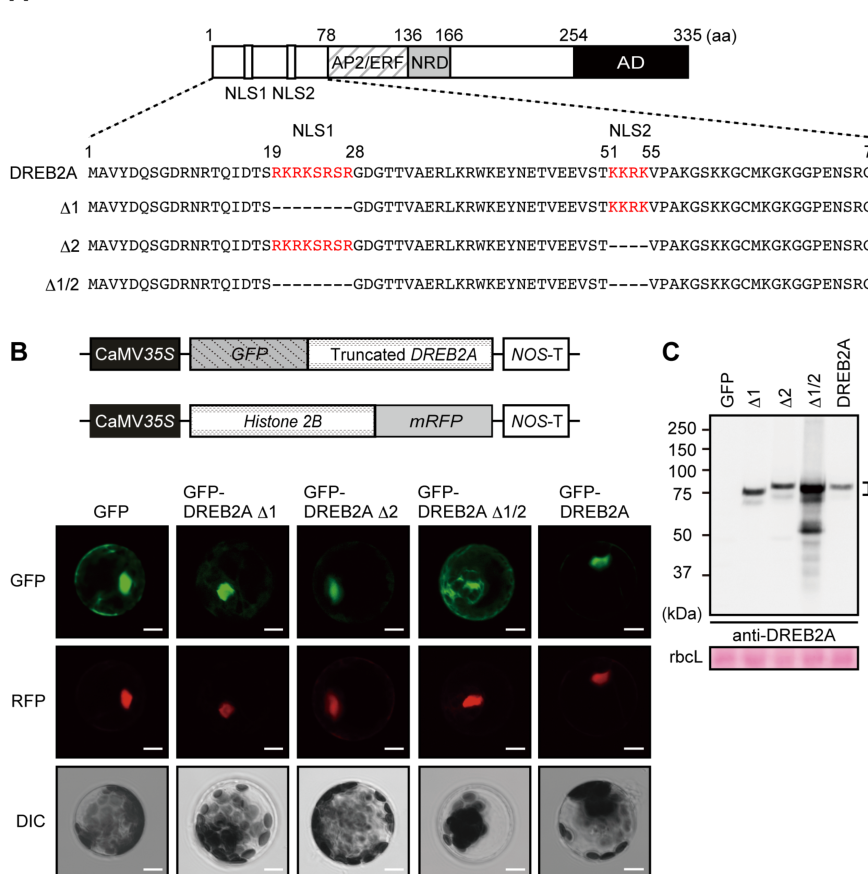
Studies examining the necessity of the nuclear localization signals for DREB2A function demonstrated that either NLS1 or NLS2 alone is sufficient to direct DREB2A to the nucleus, as proteins lacking one NLS maintained strong nuclear localization while those lacking both NLSs accumulated predominantly in the cytoplasm[7]. Importantly, DREB2A lacking both nuclear localization signals shows increased stability compared to wild-type DREB2A, suggesting that the nuclear import process may be coupled to the degradation machinery[7][23]. This finding implies that DREB2A degradation occurs primarily within the nucleus, where DRIP1 and DRIP2 interact with and ubiquitinate the protein[23]. The restricted, nucleus-specific degradation of DREB2A provides an additional layer of regulatory specificity, as cytoplasmic DREB2A would be sequestered from its nuclear targets and rendered transcriptionally inactive even if not degraded.

The nuclear accumulation of DREB2A in response to stress was observed to be particularly prominent in root tips and cotyledons, with notably absent or very weak accumulation in guard cells[2][59]. This tissue-specific pattern of DREB2A stress response suggests that the protein functions differently or with different importance in distinct cell types, potentially reflecting tissue-specific stress perception or sensitivity. The tissue-specific nature of DREB2A function indicates that the transcription factor participates in organ- and cell-type-specific stress response circuits rather than mediating an invariant, uniform plant response.

Stress-Responsive Expression and Upstream Regulatory Elements

DREB2A gene expression is rapidly and dramatically induced in response to diverse abiotic stresses including drought, salt, and heat. The transcript levels of DREB2A increase substantially upon exposure to dehydration or osmotic stress, reaching up to 250-fold of basal levels in some experimental conditions[39]. This rapid transcriptional induction ensures that the cell can quickly generate DREB2A mRNA, which serves as the substrate for protein translation. However, the dramatic transcriptional induction of DREB2A must be considered in light of the post-translational mechanisms that prevent translated DREB2A protein from accumulating until stress-dependent stabilization signals are received.

The dehydration and heat-stress responsive expression of DREB2A is mediated through distinct cis-acting elements in the DREB2A promoter region, revealing that these two types of stress activate DREB2A through partially independent signaling pathways[39][52]. In response to heat stress, the expression of DREB2A is controlled through heat shock elements (HSE) in its promoter region that are recognized by heat shock factors (HSFs), particularly HsfA1a, HsfA1b, and HsfA1d[15][39][52]. Heat stress-induced expression of DREB2A was completely suppressed in plants lacking functional copies of HsfA1a, HsfA1b, and HsfA1d, but could be restored by introducing a transgene expressing HsfA1b into the triple mutant background[39][52]. This demonstrates that these heat shock factors are essential positive regulators of DREB2A transcription during heat stress. In response to osmotic stress (drought or high salinity), the expression of DREB2A is mediated through an abscisic acid-responsive element (ABRE) and a coupling element 3-like sequence (CE3) in the DREB2A promoter[39][52]. The ABRE-binding proteins/factors (AREB/ABFs) were identified as major transcription factors that activate DREB2A transcription through the ABRE sequence in response to osmotic stress[39][52]. However, the transcription factors that recognize the coupling element 3-like sequence in the osmotic stress response have not yet been definitively identified.

Importantly, a negative regulator of DREB2A expression was identified through transient expression assays and promoter analysis. GROWTH-REGULATING FACTOR 7 (GRF7), a plant-specific transcription factor, specifically binds to a region of the DREB2A promoter designated Region S and represses DREB2A transcription under normal, non-stressful conditions[49][52]. GRF7 binding targets a GTE element (GRF7-binding target element) identified as TGTCAGG in the DREB2A promoter[49][52]. Plants deficient in GRF7 showed elevated DREB2A transcript levels under non-stressful conditions, corresponding inversely with GRF7 expression levels[49]. This GRF7-mediated repression of DREB2A appears to function as a growth-promoting mechanism, preventing inappropriate activation of stress-responsive genes that would otherwise retard normal vegetative growth. Rescue experiments confirmed that expressing wild-type GRF7 from its native promoter in grf7 mutant plants restored normal DREB2A expression patterns[49]. Thus, GRF7 acts as a rheostat controlling basal DREB2A expression, maintaining appropriately low levels under non-stressful conditions to balance the competing developmental demands of growth versus stress preparedness.

Alternative Splicing and Regulatory Diversity

Recent research has uncovered an additional layer of DREB2A regulation through alternative splicing of the DREB2A pre-mRNA, which generates protein isoforms with distinct functional properties[44][47][52]. Under heat stress conditions, an alternatively spliced variant of DREB2A pre-mRNA accumulates that encodes a truncated protein designated DREB2A.2[47][52]. This alternatively spliced DREB2A.2 isoform lacks a specific protein-interaction motif (the CMIV-3 motif or RCD1-binding domain) that mediates the interaction between full-length DREB2A and RADICAL-INDUCED CELL DEATH 1 (RCD1), a pleiotropic regulator of stress and developmental responses[38][41][47][52]. The functional significance of generating DREB2A.2 during heat stress lies in removing the interaction surface that enables RCD1-mediated regulation, thereby liberating DREB2A from RCD1 inhibition and allowing full transcriptional activation[38][41][52]. The production of this alternatively spliced form represents a sophisticated regulatory strategy whereby plants dynamically switch between distinct DREB2A protein forms depending on stress conditions, using alternative splicing as a molecular switch to tune DREB2A activity. This mechanism demonstrates that a single gene locus can generate multiple regulatory outputs through RNA processing, adding considerable flexibility to plant stress responses.

Protein-Protein Interactions and Cofactor Requirement

While DREB2A contains an intrinsic transcriptional activation domain in its carboxy-terminal region, evidence indicates that DREB2A function is enhanced through interactions with specific cofactors that increase its transcriptional activity or specificity. Through yeast two-hybrid screening using DREB2A as bait, several novel interacting proteins have been identified. NUCLEAR FACTOR Y (NF-Y) proteins, particularly the NF-YC subunit designated DPB3-1 (DNA POLYMERASE II subunit B3-1), specifically interact with DREB2A[52][57]. The interaction between DREB2A and the NF-Y complex (which comprises NF-YA, NF-YB, and NF-YC subunits) enhances DREB2A-mediated transactivation of specific target genes, particularly heat-responsive genes such as HsfA3[52][57]. Notably, overexpression of DPB3-1 in transgenic Arabidopsis enhanced the expression of heat stress-responsive target genes of DREB2A without affecting the expression of drought-inducible DREB2A targets, indicating that this NF-Y coactivator complex specifically enhances DREB2A activity in the heat stress context[52][57]. This stress-specific cofactor requirement provides another mechanism for the selective activation of different DREB2A target gene sets under distinct stress conditions.

The interaction between DREB2A and RCD1 (RADICAL-INDUCED CELL DEATH 1) represents another important protein-protein interaction with regulatory consequences[38][41]. RCD1 is a member of the poly(ADP-ribose) polymerase (PARP) superfamily with multiple functions in plant development and stress responses[38][41]. The interaction between RCD1 and DREB2A is mediated by a specific protein-interaction motif in DREB2A, and this interaction modulates DREB2A function under various conditions including stress and senescence[38][41]. As noted above, the heat stress-induced alternatively spliced DREB2A.2 isoform lacks this RCD1-binding motif, suggesting that removing RCD1-mediated inhibition of DREB2A is important for achieving full activation during heat stress[38][41][47][52]. Thus, the RCD1-DREB2A interaction represents a negative regulatory mechanism that can be overcome through alternative splicing or stress-dependent disruption.

Functional Roles in Stress Response

DREB2A occupies a central position in plant responses to multiple types of abiotic stress, functioning as a hub that integrates and coordinates distinct stress-signaling pathways. The most thoroughly characterized function of DREB2A is its role in conferring drought and salt stress tolerance through the activation of osmoprotective gene expression. Transgenic Arabidopsis plants overexpressing a constitutively active form of DREB2A (DREB2A-CA) showed significant improvements in tolerance to drought stress, maintaining higher survival rates and better growth under water-limiting conditions compared to wild-type plants[1][5][6][19][45]. The drought tolerance phenotype correlates with elevated expression of LEA proteins and other osmoprotective molecules encoded by DREB2A target genes. In contrast, T-DNA insertion mutant plants carrying disrupted DREB2A (dreb2a mutants) displayed reduced drought tolerance and diminished expression of DREB2A-regulated genes under drought stress[2][14][28][39]. These gain-of-function and loss-of-function studies conclusively demonstrate that DREB2A is necessary and sufficient for drought tolerance in Arabidopsis.

Beyond its role in drought stress responses, DREB2A was discovered to function importantly in heat stress responses and thermotolerance[2][15][28][33][50]. Transgenic Arabidopsis overexpressing DREB2A-CA showed significantly increased thermotolerance, surviving exposure to temperatures that killed wild-type plants, and conversely, dreb2a mutant plants displayed reduced basal thermotolerance[2][14][28]. The discovery of DREB2A's heat-stress role was unexpected given its initial identification as a dehydration-responsive factor, but subsequent research revealed that DREB2A responds to heat stress through distinct regulatory pathways and activates partially distinct gene sets appropriate to the heat stress context[2][28]. DREB2A expression is rapidly induced by heat stress, and the DREB2A protein accumulates in the nucleus during heat stress, enabling it to activate heat-inducible genes[2][28][59]. This heat-stress function reveals sophisticated crosstalk between water and temperature stress responses, with a single transcription factor capable of appropriately regulating distinct transcriptional programs depending on stress context.

The molecular basis for DREB2A's capacity to selectively regulate different target genes under drought versus heat stress remains incompletely understood but likely involves stress-dependent cofactor recruitment and post-translational modifications. Under drought stress, DREB2A primarily induces LEA proteins and osmolyte biosynthesis genes that enhance cellular osmotic adjustment. Under heat stress, DREB2A induces heat shock proteins and other molecular chaperones that combat protein denaturation. The identification of distinct cofactors like DPB3-1 that preferentially enhance heat-responsive DREB2A targets provides one mechanism for this selectivity, but additional mechanisms likely exist.

Integration with ABA-Independent Osmotic Stress Signaling

An important characteristic of DREB2A is that it functions in an ABA-independent pathway for osmotic stress response, in addition to participating in the canonical ABA-dependent pathway[27][30]. Plants exposed to osmotic stress activate both ABA-dependent and ABA-independent signaling cascades, and DREB2A appears to be a key component of the ABA-independent response arm. The DREB2A promoter contains ABRE elements that are activated by ABA-responsive transcription factors (AREB/ABFs) in the ABA-dependent pathway, but DREB2A is also induced by osmotic stress through ABA-independent mechanisms[39]. Genetic analysis of triple SnRK2 kinase mutants (which are essential components of ABA signaling) revealed that DREB2A is expressed and can activate downstream genes in these ABA-insensitive backgrounds during osmotic stress[27]. This indicates that DREB2A-mediated stress responses can proceed independently of ABA signaling, providing plants with multiple, partially redundant mechanisms for osmotic stress adaptation. The existence of parallel ABA-dependent and ABA-independent pathways creates a robust stress-response system resistant to disruption of any single signaling branch.

Comparative Genomics and Evolutionary Conservation

The DREB2 subfamily comprises eight members in Arabidopsis (DREB2A through DREB2H), but DREB2A and DREB2B emerge as the major, stress-inducible members[1][6][14]. Among the eight DREB2-type proteins in Arabidopsis, only DREB2A and DREB2B are strongly induced by drought and high salinity stress, while the other six homologs show very low or undetectable induction under stress conditions[1][6][14][25]. This functional specialization indicates that DREB2A and DREB2B have evolved as the primary stress-responsive members of the DREB2 subfamily, with the other family members potentially fulfilling specialized roles in non-stress contexts or in response to other environmental signals.

DREB2 homologous genes have been isolated from numerous crop species, including rice, wheat, barley, maize, pearl millet, foxtail millet, soybean, chickpea, and poplar, demonstrating the conservation of this gene family across plant taxa[14][45][52]. Notably, DREB2 orthologs from crop species often exhibit similar biochemical properties to Arabidopsis DREB2A, including the presence of negative regulatory domains and requirement for post-translational modification for activation[14][45]. In soybean, a DREB2A ortholog designated GmDREB2A;2 was shown to activate transcription through DRE elements and to improve drought and heat stress tolerance in transgenic Arabidopsis plants[45]. However, GmDREB2A;2 exhibits important differences from Arabidopsis DREB2A, including subtle variations in the negative regulatory sequence and differential effects on specific gene expression patterns[45]. These findings suggest that while the core DREB2 function has been conserved during plant evolution, lineage-specific variations have occurred that fine-tune the protein's regulatory properties for adaptation to species-specific stress environments.

Downstream Effector Genes and Protection Mechanisms

The protective functions conferred by DREB2A-regulated genes operate through multiple complementary molecular mechanisms. Late embryogenesis abundant (LEA) proteins, which constitute the largest class of DREB2A direct targets, function through multiple mechanisms to protect cells from desiccation damage[1][9][25][37]. Some LEA proteins form protective complexes that stabilize membrane structure and prevent aggregation of cellular proteins during water stress[1][9][37]. Other LEA proteins function as molecular chaperones, preventing protein misfolding and aggregation in the dehydrated cellular environment[1][9][37]. The accumulation of multiple LEA protein species through DREB2A-driven transcription creates redundancy and ensures comprehensive protection across distinct subcellular compartments and against various types of desiccation-induced damage.

Heat shock proteins activated downstream of DREB2A through the HsfA3 cascade function as molecular chaperones that prevent protein denaturation and aggregation during elevated temperatures[2][15][33][59]. The HSP70, HSP90, small HSP, and other heat shock protein classes activated downstream of DREB2A maintain cellular protein homeostasis by facilitating proper protein folding and by sequestering aggregation-prone proteins into productive folding pathways[2][15][33][59]. The generation of multiple HSP classes through the DREB2A-HsfA3 transcriptional cascade ensures that diverse types of misfolded proteins encountered during heat stress can be accommodated by appropriate chaperone machinery.

Other important DREB2A target genes encode proteins involved in osmolyte biosynthesis, including galactinol synthase genes (GolS) that catalyze the early steps in raffinose family oligosaccharide synthesis[2][28][59]. These oligosaccharides accumulate during osmotic stress and function as osmoprotectants that maintain cellular turgor pressure and protect macromolecules from osmotic damage[2][28][59]. The coordinate induction of multiple osmolyte biosynthesis genes through DREB2A ensures sufficient accumulation of protective osmolytes to counter the effects of drought or salinity stress.

Recent Discoveries and Emerging Mechanisms

Recent investigations have revealed additional regulatory layers controlling DREB2A function, particularly mechanisms involving post-translational modifications beyond phosphorylation. Research on thermosensitive SUMOylation of related heat-stress transcription factors suggests that protein modification by SUMO conjugation may also regulate DREB2A, though this has not been definitively demonstrated[24]. Studies examining the role of various kinase families in DREB2A-mediated stress responses have identified numerous candidate upstream regulators that may coordinate DREB2A activation with broader signaling networks[27][30][31]. The discovery that specific splice variants of DREB2A accumulate under distinct stress conditions adds a new dimension to understanding how plants generate transcriptional specificity in responses to different environmental challenges[44][47].

Investigation of the lipid signaling pathways controlling DREB2A revealed that the phosphoinositide-specific phospholipase C (PI-PLC) pathway constitutively represses DREB2A expression under non-stress conditions[12][22]. When basal PI-PLC activity is experimentally inhibited, multiple DREB2 genes including DREB2A are rapidly upregulated, and target genes of DREB2A are also induced[12][22]. This indicates that lipid signaling molecules including diacylglycerol and phosphatidic acid maintain repression of DREB2A under normal conditions, and that disruption of this repression (either by stress signals or experimental manipulation) permits DREB2A induction. The existence of this lipid-signaling-dependent repression suggests that plants use multiple, parallel regulatory mechanisms to ensure the tight control of this potent transcriptional activator.

Practical Applications and Biotechnological Potential

The capacity of DREB2A to improve plant tolerance to multiple stress conditions while increasing expression of protective genes has made it a priority target for crop improvement through genetic engineering. Transgenic crops expressing constitutively active forms of DREB2A or orthologs from related species have shown enhanced drought and heat tolerance in various experimental systems[14][52]. However, challenges remain in translating these laboratory findings into practical crop improvement strategies, particularly regarding the growth retardation phenotype observed in plants constitutively overexpressing DREB2A[1][5][6][19][45]. The use of stress-inducible promoters to drive DREB2A-CA expression instead of constitutive promoters represents a promising approach to achieve stress tolerance improvements while minimizing negative effects on normal growth[1][43]. For example, transgenic Arabidopsis plants overexpressing DREB2A-CA under the control of the RD29A stress-inducible promoter showed enhanced drought tolerance with minimal growth retardation compared to plants expressing DREB2A-CA under the constitutive CaMV 35S promoter[1][43].

The recent elucidation of DREB2A's post-translational regulatory mechanisms opens new possibilities for crop improvement through targeting specific regulatory components. Manipulation of casein kinase 1 activity or DRIP1/DRIP2 E3 ligase function could potentially enhance DREB2A stability or activity without the need for genetic transformation, through either chemical treatment or conventional breeding approaches targeting regulatory mutations[3][31][40][46]. The identification of cofactors like DPB3-1 that enhance specific DREB2A functions suggests that coordinated manipulation of multiple genes could achieve additive or synergistic stress tolerance improvements[52][57].

Genome editing approaches utilizing CRISPR/Cas9 or other modern genetic technologies offer exciting possibilities for enhancing DREB2A function in economically important crops[52]. Targeted insertion of enhancer sequences upstream of the DREB2A promoter could increase the strength of stress induction while retaining the normal regulatory properties of the endogenous DREB2A locus. Alternatively, genome editing could be used to introduce loss-of-function mutations in negative regulators like GRF7 to de-repress basal DREB2A expression[49][52]. Such approaches could enhance the stress responsiveness of crops without requiring transgene introduction and the associated regulatory hurdles.

Conclusion

DREB2A represents a paradigm example of how plants achieve precise temporal and spatial control of powerful transcriptional regulators through multilayered post-translational regulatory mechanisms. The protein functions as a sophisticated molecular hub that integrates distinct stress signals—dehydration, salt stress, and heat—through distinct upstream pathways while coordinating partially overlapping transcriptional programs appropriate to each stress context. The remarkable discovery that DREB2A activity is controlled through stress-dependent changes in the phosphorylation status of a single regulatory domain provides an elegant molecular mechanism for rapid stress sensing and response. The identification of DREB2A's cofactors, protein-protein interactions, and subcellular dynamics reveals that transcriptional control involves not merely the presence or absence of a transcription factor but rather its dynamic modification, localization, and interaction with regulatory partners. Future research will likely reveal additional post-translational modifications and cofactor requirements that enable DREB2A to fine-tune its activity in response to subtle variations in stress intensity, duration, and combination with other environmental factors. The practical applications of DREB2A in crop improvement remain substantial, particularly when integrated with complementary stress tolerance mechanisms and deployed through appropriately regulated genetic constructs. The continued investigation of DREB2A and related transcription factors will advance our fundamental understanding of plant stress physiology while providing tools for developing more resilient crops capable of sustained productivity in increasingly challenging environmental conditions.

Citations

  1. https://pmc.ncbi.nlm.nih.gov/articles/PMC1456870/
  2. https://www.pnas.org/doi/10.1073/pnas.0605639103
  3. https://pubmed.ncbi.nlm.nih.gov/30487287/
  4. https://www.uniprot.org/uniprotkb/O82132/entry
  5. https://pubmed.ncbi.nlm.nih.gov/16617101/
  6. https://academic.oup.com/jxb/article/62/14/4731/482713
  7. https://journals.plos.org/plosone/article?id=10.1371%2Fjournal.pone.0080457
  8. https://pmc.ncbi.nlm.nih.gov/articles/PMC1693746/
  9. https://www.frontiersin.org/journals/plant-science/articles/10.3389/fpls.2013.00307/full
  10. https://pubmed.ncbi.nlm.nih.gov/17999647/
  11. https://www.frontiersin.org/journals/plant-science/articles/10.3389/fpls.2020.572137/pdf
  12. https://www.frontiersin.org/journals/plant-science/articles/10.3389/fpls.2022.837152/full
  13. https://pmc.ncbi.nlm.nih.gov/articles/PMC2483357/
  14. https://pmc.ncbi.nlm.nih.gov/articles/PMC3620551/
  15. https://pmc.ncbi.nlm.nih.gov/articles/PMC3737466/
  16. https://www.frontiersin.org/journals/plant-science/articles/10.3389/fpls.2014.00135/full
  17. https://academic.oup.com/plcell/article/35/10/3889/7218295
  18. https://academic.oup.com/plcell/article/18/5/1292/6114945
  19. https://www.nature.com/articles/s41467-020-19977-2
  20. https://pmc.ncbi.nlm.nih.gov/articles/PMC8125534/
  21. https://pmc.ncbi.nlm.nih.gov/articles/PMC6341385/
  22. https://pure.mpg.de/rest/items/item_1814226/component/file_1814225/content
  23. https://pmc.ncbi.nlm.nih.gov/articles/PMC6747015/
  24. https://pmc.ncbi.nlm.nih.gov/articles/PMC4844398/
  25. https://onlinelibrary.wiley.com/doi/pdf/10.1111/j.1365-313X.2007.03334.x
  26. https://portlandpress.com/biochemj/article/442/3/573/81085/RCD1-DREB2A-interaction-in-leaf-senescence-and
  27. https://pmc.ncbi.nlm.nih.gov/articles/PMC3462639/
  28. https://pubmed.ncbi.nlm.nih.gov/22150398/
  29. https://onlinelibrary.wiley.com/doi/10.1111/pce.12591/suppinfo
  30. https://www.frontiersin.org/journals/plant-science/articles/10.3389/fpls.2022.911277/full
  31. https://pmc.ncbi.nlm.nih.gov/articles/PMC3532265/
  32. https://pmc.ncbi.nlm.nih.gov/articles/PMC8483784/
  33. https://academic.oup.com/jxb/article/68/9/2135/3737317
  34. https://pmc.ncbi.nlm.nih.gov/articles/PMC5066641/
  35. https://pmc.ncbi.nlm.nih.gov/articles/PMC4311209/
  36. https://www.ncbi.nlm.nih.gov/gene?Db=gene&Cmd=DetailsSearch&Term=830424
  37. https://www.cabidigitallibrary.org/doi/full/10.5555/20193504632

Notes

(AT5G05410-notes.md)

DREB2A (AT5G05410) Curation Notes

Gene Summary

DREB2A = Dehydration-Responsive Element Binding Protein 2A
CRITICAL INTEGRATOR: Drought AND Heat stress responses through distinct pathways [deep-research]

UNIQUE FUNCTION - Cross-Stress Integrator

DREB2A coordinates BOTH drought and heat stress responses through stress-specific transcriptional programs [deep-research]

Mechanism:

  • Drought stress: Activates LEA proteins, osmoprotective genes (osmotic adjustment) [deep-research]
  • Heat stress: Activates HSFA3 → heat shock proteins (protein protection) [deep-research]
  • Same transcription factor, different outputs depending on stress context [deep-research]
  • Stress-specific cofactors (e.g., DPB3-1/NF-YC enhances heat targets only) [deep-research]

Primary Function

Sequence-Specific Transcription Factor (CORE)

  • AP2/ERF family: Conserved ERF/AP2 DNA-binding domain (aa 68-133) [deep-research]
  • DNA recognition: Binds DRE (Dehydration-Responsive Element) sequences [deep-research]
  • Sequence preference: ACCGAC (vs DREB1A preferring A/GCCGACNT) [deep-research]
  • Transcriptional activator: C-terminal activation domain (aa 254-335) [deep-research]

Domain Architecture:

  • N-terminal: Nuclear localization signals (NLS1, NLS2) [deep-research]
  • Central: ERF/AP2 DNA-binding domain (aa 68-133) [deep-research]
  • Negative Regulatory Domain (NRD): aa 136-165, CRITICAL for regulation [deep-research]
  • C-terminal: Transcriptional activation domain (acidic residues) [deep-research]
  • PEST sequence: Phosphorylation target sites [deep-research]

POST-TRANSLATIONAL REGULATION (CRITICAL MECHANISM)

Constitutive Degradation Under Normal Conditions:

Paradox: DREB2A mRNA is constitutively expressed, but protein is RAPIDLY degraded [deep-research]

DRIP1/DRIP2-Mediated Degradation:

  • DRIP1, DRIP2: C3HC4 RING E3 ubiquitin ligases [deep-research]
  • Nuclear localization: Interact with DREB2A in nucleus [deep-research]
  • Ubiquitination: DRIP1/DRIP2 + E2 (UBCH5c) → polyubiquitination [deep-research]
  • 26S proteasome: Degrades ubiquitinated DREB2A [deep-research]
  • drip1 drip2 double mutants: DREB2A accumulates, enhanced drought tolerance [deep-research]

Stress-Induced Stabilization:

Casein Kinase 1 (CK1)-Mediated Phosphorylation:

  • Normal conditions: CK1 phosphorylates NRD (Ser/Thr residues) → degradation signal [deep-research]
  • Heat stress (40°C): NRD becomes DEPHOSPHORYLATED → blocks ubiquitination [deep-research]
  • Temperature sensor: Dephosphorylation at 40°C, minimal at 32°C [deep-research]
  • PF-670462 (CK1 inhibitor): Causes DREB2A accumulation in non-phosphorylated form [deep-research]
  • Mechanism: NRD = temperature-sensitive conditional degradation signal [deep-research]

Result:

  • Rapid response capacity: mRNA already present, protein stabilization triggers activation [deep-research]
  • Prevents inappropriate activation: Degradation under normal conditions prevents growth retardation [deep-research]
  • Elegant thermosensor: Phosphorylation status changes with temperature [deep-research]

Target Genes and Transcriptional Programs

Microarray Analysis (DREB2A-CA overexpression):

  • 36 genes >8-fold induced [deep-research]
  • 29/36 have DRE sequences in 1000-bp upstream regions (direct targets) [deep-research]

Direct Target Gene Classes:

1. Late Embryogenesis Abundant (LEA) Proteins (9 genes):

  • Function: Protect proteins, enzymes, lipids from dehydration [deep-research]
  • Examples: RD29A, RD29B, RD17, LEA14 [deep-research]
  • Drought-responsive [deep-research]

2. Heat Shock Factor A3 (HSFA3):

  • CRITICAL: DREB2A → HSFA3 → Heat Shock Proteins cascade [deep-research]
  • Highest expression ratio in DREB2A-CA plants [deep-research]
  • Heat-specific: Amplifies heat stress response signal [deep-research]
  • Hierarchical regulation: Master regulator (DREB2A) → Amplifier (HSFA3) → Effectors (HSPs) [deep-research]

3. Osmoprotective Genes:

  • Galactinol synthase (GolS): Raffinose family oligosaccharide synthesis [deep-research]
  • Function: Osmoprotectants, maintain turgor, protect macromolecules [deep-research]

4. Stress-Responsive Genes:

  • COR15A, KIN1, KIN2, COR15B: Osmotic stress tolerance [deep-research]

Stress-Dependent Target Selectivity:

  • Drought stress: Preferentially induces LEA proteins, osmolyte genes [deep-research]
  • Heat stress: Preferentially induces HSPs, heat shock factors [deep-research]
  • Both stresses: Third group induced by both [deep-research]
  • NOT simple on-off switch: Stress-dependent transcriptional programs [deep-research]

Upstream Regulation

Transcriptional Induction:

Heat Stress Pathway:

  • Heat Shock Elements (HSE) in DREB2A promoter [deep-research]
  • HSFA1a, HSFA1b, HSFA1d: Essential positive regulators [deep-research]
  • hsfa1a/b/d triple mutant: Complete suppression of heat-induced DREB2A [deep-research]
  • HsfA1b rescue: Restores DREB2A expression [deep-research]

Osmotic Stress Pathway:

  • ABRE (ABA-responsive element) in DREB2A promoter [deep-research]
  • CE3-like sequence (coupling element 3) [deep-research]
  • AREB/ABF transcription factors: Activate through ABRE [deep-research]
  • Up to 250-fold induction under dehydration [deep-research]

Transcriptional Repression:

GRF7 (Growth-Regulating Factor 7):

  • Binds DREB2A promoter at "Region S" (GTE element: TGTCAGG) [deep-research]
  • Negative regulator under normal conditions [deep-research]
  • grf7 mutants: Elevated DREB2A expression basally [deep-research]
  • Function: Balance growth vs stress preparedness (growth-promoting) [deep-research]

Phosphoinositide-Specific Phospholipase C (PI-PLC):

  • Constitutive repression of DREB2A under normal conditions [deep-research]
  • PI-PLC inhibition: Rapid DREB2A upregulation [deep-research]
  • Lipid signaling: DAG, phosphatidic acid maintain repression [deep-research]

Alternative Splicing - Regulatory Diversity

DREB2A.2 Isoform:

  • Heat stress-induced alternative splicing [deep-research]
  • Truncated protein: Lacks CMIV-3 motif (RCD1-binding domain) [deep-research]
  • Function: Removes RCD1-mediated inhibition during heat stress [deep-research]
  • Mechanism: Molecular switch - RNA processing tunes DREB2A activity [deep-research]

Functional Significance:

  • Full-length DREB2A: Subject to RCD1 regulation [deep-research]
  • DREB2A.2: Liberated from RCD1 inhibition → full activation [deep-research]
  • Stress-dependent switch: Different protein forms for different conditions [deep-research]

Protein-Protein Interactions

Cofactors (Enhance Activity):

Nuclear Factor Y (NF-Y) Complex:

  • DPB3-1 (NF-YC subunit): Interacts with DREB2A [deep-research]
  • Enhanced transactivation: Specifically for HEAT-responsive targets [deep-research]
  • Stress-specific: DPB3-1 overexpression enhances heat targets, NOT drought targets [deep-research]
  • Mechanism: Cofactor-dependent target selectivity [deep-research]

Negative Regulators:

RCD1 (Radical-Induced Cell Death 1):

  • Poly(ADP-ribose) polymerase (PARP) superfamily [deep-research]
  • Modulates DREB2A function during stress and senescence [deep-research]
  • Inhibitory interaction: Removed by alternative splicing (DREB2A.2) [deep-research]

Subcellular Localization

  • Nuclear (primary site of function) [deep-research]
  • NLS1, NLS2: Either alone sufficient for nuclear import [deep-research]
  • Weak nuclear signal under normal conditions (rapid degradation) [deep-research]
  • Strong nuclear accumulation during heat stress (stabilization) [deep-research]
  • Tissue-specific: Prominent in root tips, cotyledons; absent/weak in guard cells [deep-research]
  • Nucleus-specific degradation: DRIP1/DRIP2 interact in nucleus [deep-research]

Functional Roles

1. Drought and Salt Stress Tolerance (PRIMARY):

  • DREB2A-CA overexpression: Significant drought tolerance improvement [deep-research]
  • dreb2a mutants: Reduced drought tolerance, diminished target gene expression [deep-research]
  • Osmotic adjustment: LEA proteins, osmoprotectants [deep-research]
  • Necessary and sufficient for drought tolerance [deep-research]

2. Heat Stress Tolerance (CO-PRIMARY):

  • DREB2A-CA overexpression: Increased thermotolerance [deep-research]
  • dreb2a mutants: Reduced basal thermotolerance [deep-research]
  • DREB2A → HSFA3 cascade: Amplifies heat response [deep-research]
  • Unexpected discovery: Initially identified as dehydration factor [deep-research]
  • Crosstalk: Water and temperature stress responses integrated [deep-research]

3. ABA-Independent Osmotic Stress Pathway:

  • Dual pathways: ABA-dependent AND ABA-independent [deep-research]
  • ABRE elements: Connect to ABA-dependent pathway [deep-research]
  • SnRK2 triple mutants: DREB2A still induced by osmotic stress (ABA-independent) [deep-research]
  • Robust system: Multiple parallel pathways [deep-research]

DREB2 Family Context

Arabidopsis DREB2 Subfamily:

  • 8 members: DREB2A-H [deep-research]
  • Stress-inducible: DREB2A, DREB2B (major members) [deep-research]
  • Other 6 members: Very low/undetectable stress induction [deep-research]
  • Functional specialization: DREB2A/B = primary stress responders [deep-research]

Evolutionary Conservation:

  • Crop orthologs: Rice, wheat, barley, maize, pearl millet, soybean, chickpea, poplar [deep-research]
  • Conserved features: NRD, post-translational regulation [deep-research]
  • GmDREB2A;2 (soybean): Improves drought/heat in transgenic Arabidopsis [deep-research]
  • Species-specific variations: Fine-tuning for species-specific stress environments [deep-research]

Biotechnological Applications

Challenges:

  • Growth retardation: Constitutive DREB2A-CA overexpression retards growth [deep-research]
  • Energy cost: Constitutive stress preparation vs normal development [deep-research]

Solutions:

  • Stress-inducible promoters: RD29A promoter → enhanced tolerance, minimal growth retardation [deep-research]
  • CK1 manipulation: Target regulatory components (CK1, DRIP1/DRIP2) [deep-research]
  • Cofactor coordination: DPB3-1 + DREB2A for additive effects [deep-research]
  • Genome editing: CRISPR/Cas9 for enhancer insertion, GRF7 knockout [deep-research]
  • Avoid transgenes: Regulatory mutations via conventional breeding [deep-research]

Curation Strategy

  1. ACCEPT core molecular function annotations:
  2. Sequence-specific DNA binding transcription factor
  3. DNA-binding transcription factor activity
  4. cis-regulatory region sequence-specific DNA binding
  5. DRE/CRT element binding

  6. ACCEPT biological process annotations:

  7. Response to water deprivation
  8. Response to salt stress
  9. Response to heat
  10. Response to osmotic stress
  11. Cellular response to dehydration
  12. Positive regulation of transcription

  13. ACCEPT localization annotations:

  14. Nucleus (primary site of function)

  15. EMPHASIZE key features:

  16. CROSS-STRESS INTEGRATOR (drought AND heat)
  17. Post-translational regulation (DRIP1/DRIP2, CK1 phosphorylation)
  18. DREB2A → HSFA3 → HSP cascade (hierarchical)
  19. Alternative splicing (DREB2A.2 for heat stress)
  20. Stress-specific cofactors (DPB3-1 for heat targets)
  21. Constitutive degradation, stress-induced stabilization

  22. NOTE important relationships:

  23. Upstream: HSFA1a/b/d (heat), AREB/ABF (osmotic)
  24. Downstream: HSFA3 (heat), LEA proteins (drought), HSPs
  25. Negative regulators: GRF7, RCD1, DRIP1/DRIP2, PI-PLC
  26. Cofactors: DPB3-1/NF-YC (heat-specific enhancement)

Key Functional Distinctions

vs DREB1A:

  • DREB1A: Cold stress, GCCGACNT preference
  • DREB2A: Drought/heat stress, ACCGAC preference
  • Different target gene sets through DNA-binding specificity

vs HSFA1 Family:

  • HSFA1a/b/d: Upstream activators of DREB2A during heat
  • DREB2A: Downstream of HSFA1, activates HSFA3
  • Hierarchical relationship in heat stress network

vs HSFA3:

  • DREB2A: Master regulator, activates HSFA3
  • HSFA3: Amplifier, DREB2A-regulated
  • DREB2A → HSFA3 cascade is central to heat response

References

  • Deep research: AT5G05410-deep-research-perplexity.md (37 citations)
  • Key function: Cross-stress integrator coordinating drought AND heat responses through post-translational regulation and hierarchical transcriptional cascades

📄 View Raw YAML

id: O82132
gene_symbol: AT5G05410
product_type: PROTEIN
status: IN_PROGRESS
taxon:
  id: NCBITaxon:3702
  label: Arabidopsis thaliana
description: DREB2A is a sequence-specific DNA-binding transcription factor that
  functions as a critical integrator of drought and heat stress responses 
  through distinct transcriptional programs. The protein binds to DRE/CRT 
  cis-regulatory elements (preferentially ACCGAC sequences) and activates 
  stress-inducible genes including LEA proteins for drought tolerance and heat 
  shock factors (HSFA3) for heat tolerance. DREB2A is post-translationally 
  regulated through DRIP1/DRIP2-mediated ubiquitination and proteasomal 
  degradation under normal conditions, but stabilizes during stress via 
  CK1-mediated dephosphorylation of its negative regulatory domain.
existing_annotations:
  - term:
      id: GO:0005634
      label: nucleus
    evidence_type: IBA
    original_reference_id: GO_REF:0000033
    review:
      summary: Nuclear localization is well-established for DREB2A through 
        multiple experimental studies showing GFP-DREB2A fusion proteins 
        accumulate in nucleus, particularly strongly during heat stress when 
        protein is stabilized.
      action: ACCEPT
      reason: DREB2A contains two nuclear localization signals (NLS1, NLS2) and 
        functions as a transcription factor in the nucleus where it accesses 
        target gene promoters. Nuclear localization confirmed by IDA evidence in
        multiple publications.
      proposed_replacement_terms:
      additional_reference_ids:
        - PMID:16617101
        - PMID:25490919
        - PMID:18552202
      supported_by:
        - reference_id: PMID:16617101
          supporting_text: "Synthetic green fluorescent protein gave a strong signal
            in the nucleus under unstressed control conditions when fused to constitutive
            active DREB2A but only a weak signal when fused to full-length DREB2A.
            The region between DREB2A residues 136 and 165 plays a role in the stability
            of this protein in the nucleus, which is important for protein activation."
        - reference_id: PMID:25490919
          supporting_text: "NF-YB3 and DPB3-1 form a trimer with NF-YA2 in the nucleus,
            and the trimer comprises a transcriptional complex with stabilized DREB2A"
        - reference_id: PMID:18552202
          supporting_text: Jun 13. Arabidopsis DREB2A-interacting proteins 
            function as RING E3 ligases and negatively regulate plant drought 
            stress-responsive gene expression.
        - reference_id: 
            file:ARATH/AT5G05410/AT5G05410-deep-research-perplexity.md
          supporting_text: 'provider: perplexity'
  - term:
      id: GO:0006950
      label: response to stress
    evidence_type: IBA
    original_reference_id: GO_REF:0000033
    review:
      summary: This is an overly general term. DREB2A specifically responds to 
        drought, heat, and osmotic stress, not all forms of stress. Should be 
        replaced with more specific stress response terms.
      action: MODIFY
      reason: While technically correct, this term is too broad and 
        uninformative. DREB2A's core function is specifically in drought stress 
        (response to water deprivation) and heat stress (response to heat), not 
        general stress response.
      proposed_replacement_terms:
        - id: GO:0009414
          label: response to water deprivation
        - id: GO:0009408
          label: response to heat
      additional_reference_ids:
        - PMID:16617101
        - PMID:25490919
      supported_by:
        - reference_id: AT5G05410-deep-research-perplexity.md
          supporting_text: "DREB2A occupies a central position in plant responses
            to multiple types of abiotic stress, functioning as a hub that integrates
            and coordinates distinct stress-signaling pathways. The most thoroughly
            characterized function of DREB2A is its role in conferring drought and
            salt stress tolerance through the activation of osmoprotective gene expression."
        - reference_id: PMID:16617101
          supporting_text: Apr 14. Functional analysis of an Arabidopsis 
            transcription factor, DREB2A, involved in drought-responsive gene 
            expression.
        - reference_id: PMID:25490919
          supporting_text: Dec 9. Arabidopsis DPB3-1, a DREB2A interactor, 
            specifically enhances heat stress-induced gene expression by forming
            a heat stress-specific transcriptional complex with NF-Y subunits.
  - term:
      id: GO:0045893
      label: positive regulation of DNA-templated transcription
    evidence_type: IBA
    original_reference_id: GO_REF:0000033
    review:
      summary: DREB2A functions as a transcriptional activator of 
        stress-responsive genes through binding DRE/CRT elements. Well-supported
        by experimental evidence showing activation of target gene 
        transcription.
      action: ACCEPT
      reason: DREB2A has a C-terminal transcriptional activation domain (aa 
        254-335) and activates expression of drought-inducible and 
        heat-inducible genes. Multiple studies demonstrate transcriptional 
        activation function.
      proposed_replacement_terms:
      additional_reference_ids:
        - PMID:16617101
        - PMID:9707537
        - PMID:25490919
      supported_by:
        - reference_id: PMID:16617101
          supporting_text: "DREB2A domain analysis using Arabidopsis protoplasts identified
            a transcriptional activation domain between residues 254 and 335"
        - reference_id: PMID:9707537
          supporting_text: "Both the DREB1A and DREB2A proteins specifically bound
            to the DRE sequence in vitro and activated the transcription of the b-glucuronidase
            reporter gene driven by the DRE sequence in Arabidopsis leaf protoplasts."
        - reference_id: PMID:25490919
          supporting_text: Dec 9. Arabidopsis DPB3-1, a DREB2A interactor, 
            specifically enhances heat stress-induced gene expression by forming
            a heat stress-specific transcriptional complex with NF-Y subunits.
  - term:
      id: GO:0000976
      label: transcription cis-regulatory region binding
    evidence_type: IBA
    original_reference_id: GO_REF:0000033
    review:
      summary: DREB2A specifically binds to DRE/CRT cis-regulatory sequences in 
        promoters of target genes. This is accurate but could be more specific.
      action: MODIFY
      reason: While accurate, the more specific term "cis-regulatory region 
        sequence-specific DNA binding" (GO:0000987) better captures DREB2A's 
        sequence-specific binding to DRE elements with preference for ACCGAC 
        motifs.
      proposed_replacement_terms:
        - id: GO:0000987
          label: cis-regulatory region sequence-specific DNA binding
      additional_reference_ids:
        - PMID:9707537
        - PMID:16617101
      supported_by:
        - reference_id: PMID:16617101
          supporting_text: "We found that the DREB2A protein could recognize not only
            A/GCCGACNT, but also A/GCCGACNA/G/C, and prefers ACCGAC to GCCGAC."
        - reference_id: AT5G05410-deep-research-perplexity.md
          supporting_text: "DREB2A preferentially binds to ACCGAC sequences, whereas
            DREB1A has the highest affinity for A/GCCGACNT sequences. This difference
            in DNA-binding specificity has profound consequences, as it results in
            DREB2A and DREB1A regulating partially different sets of downstream genes."
        - reference_id: PMID:9707537
          supporting_text: Two transcription factors, DREB1 and DREB2, with an 
            EREBP/AP2 DNA binding domain separate two cellular signal 
            transduction pathways in drought- and low-temperature-responsive 
            gene expression, respectively, in Arabidopsis.
  - term:
      id: GO:0003700
      label: DNA-binding transcription factor activity
    evidence_type: IBA
    original_reference_id: GO_REF:0000033
    review:
      summary: This is the core molecular function of DREB2A. The protein binds 
        DNA through its ERF/AP2 domain and activates transcription. 
        Well-established through multiple studies.
      action: ACCEPT
      reason: DREB2A is a bona fide DNA-binding transcription factor with 
        conserved ERF/AP2 DNA-binding domain (aa 68-133) and C-terminal 
        activation domain. This annotation accurately represents the core 
        molecular function.
      proposed_replacement_terms:
      additional_reference_ids:
        - PMID:9707537
        - PMID:16617101
      supported_by:
        - reference_id: PMID:9707537
          supporting_text: "Two cDNA clones that encode DRE binding proteins, DREB1A
            and DREB2A, were isolated by using the yeast one-hybrid screening technique"
        - reference_id: file:ARATH/AT5G05410/AT5G05410-uniprot.txt
          supporting_text: "DNA_BIND 78..135 AP2/ERF"
        - reference_id: PMID:16617101
          supporting_text: Apr 14. Functional analysis of an Arabidopsis 
            transcription factor, DREB2A, involved in drought-responsive gene 
            expression.
  - term:
      id: GO:0003677
      label: DNA binding
    evidence_type: IEA
    original_reference_id: GO_REF:0000120
    review:
      summary: Too general. DREB2A has sequence-specific DNA-binding 
        transcription factor activity, not just general DNA binding.
      action: MODIFY
      reason: This IEA annotation is too broad. The more specific term 
        "DNA-binding transcription factor activity" (GO:0003700) is more 
        appropriate and already assigned based on IBA evidence.
      proposed_replacement_terms:
        - id: GO:0003700
          label: DNA-binding transcription factor activity
      additional_reference_ids:
      supported_by:
        - reference_id: AT5G05410-notes.md
          supporting_text: "Sequence-Specific Transcription Factor (CORE) - AP2/ERF
            family: Conserved ERF/AP2 DNA-binding domain (aa 68-133)"
  - term:
      id: GO:0003700
      label: DNA-binding transcription factor activity
    evidence_type: IEA
    original_reference_id: GO_REF:0000002
    review:
      summary: Duplicate of IBA annotation above. IEA evidence from InterPro 
        domain prediction is consistent with experimental evidence.
      action: ACCEPT
      reason: This IEA annotation based on InterPro domain recognition is 
        accurate and consistent with experimental IBA and IDA evidence for the 
        same term. Computational annotation correctly identifies the core 
        molecular function.
      proposed_replacement_terms:
      additional_reference_ids:
      supported_by:
        - reference_id: file:ARATH/AT5G05410/AT5G05410-uniprot.txt
          supporting_text: "InterPro IPR001471 AP2/ERF_dom"
  - term:
      id: GO:0005634
      label: nucleus
    evidence_type: IEA
    original_reference_id: GO_REF:0000044
    review:
      summary: Duplicate nuclear localization annotation. IEA from UniProtKB 
        subcellular location annotation is consistent with experimental 
        evidence.
      action: ACCEPT
      reason: This computational annotation based on UniProt subcellular 
        location mapping is accurate and consistent with experimental IDA 
        evidence. Correct prediction of nuclear localization.
      proposed_replacement_terms:
      additional_reference_ids:
      supported_by:
        - reference_id: file:ARATH/AT5G05410/AT5G05410-uniprot.txt
          supporting_text: "SUBCELLULAR LOCATION: Nucleus"
  - term:
      id: GO:0006355
      label: regulation of DNA-templated transcription
    evidence_type: IEA
    original_reference_id: GO_REF:0000002
    review:
      summary: Too general. DREB2A specifically functions in positive regulation
        of transcription, not just regulation.
      action: MODIFY
      reason: The more specific term "positive regulation of DNA-templated 
        transcription" (GO:0045893) is already assigned with IBA evidence and 
        better represents DREB2A's activator function rather than generic 
        regulation.
      proposed_replacement_terms:
        - id: GO:0045893
          label: positive regulation of DNA-templated transcription
      additional_reference_ids:
      supported_by:
        - reference_id: AT5G05410-notes.md
          supporting_text: "Transcriptional activator: C-terminal activation domain
            (aa 254-335)"
  - term:
      id: GO:0005515
      label: protein binding
    evidence_type: IPI
    original_reference_id: PMID:18552202
    review:
      summary: This refers to interaction with DRIP1/DRIP2 E3 ubiquitin ligases.
        While technically correct, a more informative molecular function term 
        should be used to describe DREB2A's function rather than just protein 
        binding.
      action: MARK_AS_OVER_ANNOTATED
      reason: Generic protein binding annotations are uninformative. The 
        DRIP1/DRIP2 interaction is important for DREB2A regulation but protein 
        binding itself is not a molecular function we want to emphasize. Keep 
        but mark as non-core.
      proposed_replacement_terms:
      additional_reference_ids:
      supported_by:
        - reference_id: PMID:18552202
          supporting_text: "Arabidopsis thaliana DREB2A-INTERACTING PROTEIN1 (DRIP1)
            and DRIP2"
  - term:
      id: GO:0005515
      label: protein binding
    evidence_type: IPI
    original_reference_id: PMID:19548978
    review:
      summary: This refers to interaction with RCD1 (Radical-Induced Cell Death 
        1). Generic protein binding annotation is not informative.
      action: MARK_AS_OVER_ANNOTATED
      reason: Generic protein binding annotations are uninformative. The RCD1 
        interaction is important for regulation but protein binding itself is 
        not a molecular function to emphasize. Keep but mark as non-core.
      proposed_replacement_terms:
      additional_reference_ids:
        - PMID:27881680
      supported_by:
        - reference_id: AT5G05410-notes.md
          supporting_text: "RCD1 (Radical-Induced Cell Death 1): Poly(ADP-ribose)
            polymerase (PARP) superfamily. Modulates DREB2A function during stress
            and senescence. Inhibitory interaction: Removed by alternative splicing
            (DREB2A.2)"
        - reference_id: PMID:19548978
          supporting_text: 2009 Jun 22. Unequally redundant RCD1 and SRO1 
            mediate stress and developmental responses and interact with 
            transcription factors.
        - reference_id: PMID:27881680
          supporting_text: 2016 Nov 23. Structures and Short Linear Motif of 
            Disordered Transcription Factor Regions Provide Clues to the 
            Interactome of the Cellular Hub Protein Radical-induced Cell Death1.
  - term:
      id: GO:0005515
      label: protein binding
    evidence_type: IPI
    original_reference_id: PMID:21536906
    review:
      summary: This refers to interaction with MED25 mediator subunit. Generic 
        protein binding annotation is not informative.
      action: MARK_AS_OVER_ANNOTATED
      reason: Generic protein binding annotations are uninformative. The MED25 
        interaction may be important but protein binding itself is not a 
        molecular function to emphasize. Keep but mark as non-core.
      proposed_replacement_terms:
      additional_reference_ids:
      supported_by:
        - reference_id: file:ARATH/AT5G05410/AT5G05410-uniprot.txt
          supporting_text: "Interacts with MED25"
        - reference_id: PMID:21536906
          supporting_text: The Arabidopsis thaliana Med25 mediator subunit 
            integrates environmental cues to control plant development.
  - term:
      id: GO:0005515
      label: protein binding
    evidence_type: IPI
    original_reference_id: PMID:32612234
    review:
      summary: Part of phytohormone protein interaction network study. Generic 
        protein binding annotation is not informative about DREB2A's specific 
        function.
      action: MARK_AS_OVER_ANNOTATED
      reason: Generic protein binding annotations are uninformative. Large-scale
        interaction studies often generate these annotations but they don't 
        describe molecular function. Keep but mark as non-core.
      proposed_replacement_terms:
      additional_reference_ids:
      supported_by:
        - reference_id: GO_REF
          supporting_text: "Extensive signal integration by the phytohormone protein
            network - likely from large-scale interaction study"
        - reference_id: PMID:32612234
          supporting_text: Jul 1. Extensive signal integration by the 
            phytohormone protein network.
  - term:
      id: GO:0005515
      label: protein binding
    evidence_type: IPI
    original_reference_id: PMID:22447446
    review:
      summary: Structural study of DREB2A-Med25 interaction. Generic protein 
        binding annotation is not informative.
      action: MARK_AS_OVER_ANNOTATED
      reason: Generic protein binding annotations are uninformative. While the 
        Med25 interaction is structurally characterized, protein binding itself 
        is not a molecular function to emphasize. Keep but mark as non-core.
      proposed_replacement_terms:
      additional_reference_ids:
      supported_by:
        - reference_id: PMID:22447446
          supporting_text: "Interactions between DNA, transcriptional regulator Dreb2a
            and the Med25 mediator subunit from Arabidopsis thaliana involve conformational
            changes"
  - term:
      id: GO:0005515
      label: protein binding
    evidence_type: IPI
    original_reference_id: PMID:27881680
    review:
      summary: Study on RCD1 interactions including DREB2A. Generic protein 
        binding annotation is not informative.
      action: MARK_AS_OVER_ANNOTATED
      reason: Generic protein binding annotations are uninformative. The RCD1 
        interaction is biologically important for regulation but protein binding
        itself is not a molecular function to emphasize. Keep but mark as 
        non-core.
      proposed_replacement_terms:
      additional_reference_ids:
      supported_by:
        - reference_id: PMID:27881680
          supporting_text: "Structures and Short Linear Motif of Disordered Transcription
            Factor Regions Provide Clues to the Interactome of the Cellular Hub Protein
            Radical-induced Cell Death1"
  - term:
      id: GO:0005515
      label: protein binding
    evidence_type: IPI
    original_reference_id: PMID:25490919
    review:
      summary: This refers to interaction with DPB3-1/NF-Y complex which is 
        functionally important for heat stress-specific gene activation. Generic
        protein binding annotation is not informative.
      action: MARK_AS_OVER_ANNOTATED
      reason: Generic protein binding annotations are uninformative. While the 
        DPB3-1 interaction is functionally critical for heat stress response, 
        protein binding itself is not a molecular function to emphasize. Keep 
        but mark as non-core.
      proposed_replacement_terms:
      additional_reference_ids:
      supported_by:
        - reference_id: PMID:25490919
          supporting_text: "We identified DNA POLYMERASE II SUBUNIT B3-1 (DPB3-1),
            which was previously annotated as NUCLEAR FACTOR Y, SUBUNIT C10 (NF-YC10),
            as a DREB2A interactor, through a yeast two-hybrid screen. The overexpression
            of DPB3-1 in Arabidopsis enhanced the expression of a subset of heat stress-inducible
            DREB2A target genes but did not affect dehydration-inducible genes."
  - term:
      id: GO:0005634
      label: nucleus
    evidence_type: IDA
    original_reference_id: PMID:25490919
    review:
      summary: Direct experimental evidence for nuclear localization during heat
        stress. Consistent with other nuclear localization annotations.
      action: ACCEPT
      reason: IDA evidence from GFP-DREB2A localization studies showing nuclear 
        accumulation. This is a core cellular component annotation supported by 
        direct experimental observation.
      proposed_replacement_terms:
      additional_reference_ids:
      supported_by:
        - reference_id: PMID:25490919
          supporting_text: "NF-YB3 and DPB3-1 form a trimer with NF-YA2 in the nucleus,
            and the trimer comprises a transcriptional complex with stabilized DREB2A"
  - term:
      id: GO:0009408
      label: response to heat
    evidence_type: IDA
    original_reference_id: PMID:25490919
    review:
      summary: DREB2A is strongly induced by heat stress and critical for heat 
        stress tolerance. Direct experimental evidence from heat stress 
        experiments.
      action: ACCEPT
      reason: Heat stress response is a core biological process for DREB2A. The 
        protein is stabilized during heat stress, activates heat shock factors 
        (HSFA3) and HSPs, and DREB2A-CA overexpression improves thermotolerance.
        This is a primary function.
      proposed_replacement_terms:
      additional_reference_ids:
        - PMID:17030801
        - PMID:16617101
      supported_by:
        - reference_id: PMID:25490919
          supporting_text: "DEHYDRATION-RESPONSIVE ELEMENT BINDING PROTEIN2A (DREB2A)
            is a key transcription factor for drought and heat stress tolerance in
            Arabidopsis thaliana. DREB2A induces the expression of dehydration- and
            heat stress-inducible genes under the corresponding stress conditions."
        - reference_id: AT5G05410-notes.md
          supporting_text: "Heat stress: Activates HSFA3 → Heat Shock Proteins cascade
            (DREB2A → HSFA3 → HSPs)"
        - reference_id: PMID:17030801
          supporting_text: Dual function of an Arabidopsis transcription factor 
            DREB2A in water-stress-responsive and heat-stress-responsive gene 
            expression.
        - reference_id: PMID:16617101
          supporting_text: Apr 14. Functional analysis of an Arabidopsis 
            transcription factor, DREB2A, involved in drought-responsive gene 
            expression.
  - term:
      id: GO:0045893
      label: positive regulation of DNA-templated transcription
    evidence_type: IDA
    original_reference_id: PMID:25490919
    review:
      summary: Direct experimental evidence of transcriptional activation. 
        Consistent with IBA annotation for the same term.
      action: ACCEPT
      reason: Multiple experimental studies demonstrate DREB2A functions as a 
        transcriptional activator with acidic activation domain. IDA evidence 
        supports this core molecular function.
      proposed_replacement_terms:
      additional_reference_ids:
      supported_by:
        - reference_id: PMID:25490919
          supporting_text: "DPB3-1 could form a transcriptional complex with NF-YA
            and NF-YB subunits and that the identified trimer enhances heat stress-inducible
            gene expression during heat stress responses in cooperation with DREB2A"
  - term:
      id: GO:0000976
      label: transcription cis-regulatory region binding
    evidence_type: IPI
    original_reference_id: PMID:22037706
    review:
      summary: Y1H assay demonstrating cis-regulatory region binding. Should be 
        modified to more specific sequence-specific DNA binding term.
      action: MODIFY
      reason: While accurate, the more specific term "cis-regulatory region 
        sequence-specific DNA binding" (GO:0000987) better captures 
        sequence-specific binding to DRE elements.
      proposed_replacement_terms:
        - id: GO:0000987
          label: cis-regulatory region sequence-specific DNA binding
      additional_reference_ids:
      supported_by:
        - reference_id: PMID:22037706
          supporting_text: "Enhanced Y1H assays for Arabidopsis"
  - term:
      id: GO:0000976
      label: transcription cis-regulatory region binding
    evidence_type: IPI
    original_reference_id: PMID:25352272
    review:
      summary: Defense regulation study. Should be modified to more specific 
        sequence-specific DNA binding term.
      action: MODIFY
      reason: More specific term "cis-regulatory region sequence-specific DNA 
        binding" (GO:0000987) is more appropriate for sequence-specific DRE 
        binding.
      proposed_replacement_terms:
        - id: GO:0000987
          label: cis-regulatory region sequence-specific DNA binding
      additional_reference_ids:
      supported_by:
        - reference_id: PMID:25352272
          supporting_text: "Promoter-based integration in plant defense regulation"
  - term:
      id: GO:0000976
      label: transcription cis-regulatory region binding
    evidence_type: IPI
    original_reference_id: PMID:25533953
    review:
      summary: Secondary cell wall synthesis study. While from a non-core 
        context, the molecular function is accurate but could be more specific.
      action: MODIFY
      reason: The more specific term "cis-regulatory region sequence-specific 
        DNA binding" (GO:0000987) better captures DREB2A's sequence-specific 
        binding to DRE elements. This applies regardless of the biological 
        context in which the annotation was derived.
      proposed_replacement_terms:
        - id: GO:0000987
          label: cis-regulatory region sequence-specific DNA binding
      additional_reference_ids:
      supported_by:
        - reference_id: PMID:25533953
          supporting_text: "An Arabidopsis gene regulatory network for secondary cell
            wall synthesis"
  - term:
      id: GO:0000976
      label: transcription cis-regulatory region binding
    evidence_type: IPI
    original_reference_id: PMID:27650334
    review:
      summary: Polycomb repressive complex study. While from a non-core context,
        the molecular function is accurate but could be more specific.
      action: MODIFY
      reason: The more specific term "cis-regulatory region sequence-specific 
        DNA binding" (GO:0000987) better captures DREB2A's sequence-specific 
        binding to DRE elements. This applies regardless of the biological 
        context in which the annotation was derived.
      proposed_replacement_terms:
        - id: GO:0000987
          label: cis-regulatory region sequence-specific DNA binding
      additional_reference_ids:
      supported_by:
        - reference_id: PMID:27650334
          supporting_text: "Transcriptional Regulation of Arabidopsis Polycomb Repressive
            Complex 2 Coordinates Cell-Type Proliferation and Differentiation"
  - term:
      id: GO:0000976
      label: transcription cis-regulatory region binding
    evidence_type: IPI
    original_reference_id: PMID:30356219
    review:
      summary: Nitrogen metabolism study. While from a non-core context, the 
        molecular function is accurate but could be more specific.
      action: MODIFY
      reason: The more specific term "cis-regulatory region sequence-specific 
        DNA binding" (GO:0000987) better captures DREB2A's sequence-specific 
        binding to DRE elements. This applies regardless of the biological 
        context in which the annotation was derived.
      proposed_replacement_terms:
        - id: GO:0000987
          label: cis-regulatory region sequence-specific DNA binding
      additional_reference_ids:
      supported_by:
        - reference_id: PMID:30356219
          supporting_text: "Transcriptional regulation of nitrogen-associated metabolism
            and growth"
  - term:
      id: GO:0000976
      label: transcription cis-regulatory region binding
    evidence_type: IPI
    original_reference_id: PMID:31806676
    review:
      summary: Vascular development study. While from a non-core context, the 
        molecular function is accurate but could be more specific.
      action: MODIFY
      reason: The more specific term "cis-regulatory region sequence-specific 
        DNA binding" (GO:0000987) better captures DREB2A's sequence-specific 
        binding to DRE elements. This applies regardless of the biological 
        context in which the annotation was derived.
      proposed_replacement_terms:
        - id: GO:0000987
          label: cis-regulatory region sequence-specific DNA binding
      additional_reference_ids:
      supported_by:
        - reference_id: PMID:31806676
          supporting_text: "A PXY-Mediated Transcriptional Network Integrates Signaling
            Mechanisms to Control Vascular Development in Arabidopsis"
  - term:
      id: GO:0071456
      label: cellular response to hypoxia
    evidence_type: HEP
    original_reference_id: PMID:31519798
    review:
      summary: High-throughput expression profiling study. Hypoxia response may 
        be a peripheral function or indirect effect rather than core DREB2A 
        function.
      action: KEEP_AS_NON_CORE
      reason: While DREB2A may be induced during hypoxia, this is not a 
        well-established core function compared to drought and heat stress. HEP 
        evidence from high-throughput study is weaker than direct functional 
        studies. Keep but mark as non-core.
      proposed_replacement_terms:
      additional_reference_ids:
      supported_by:
        - reference_id: PMID:31519798
          supporting_text: "Integrative Analysis from the Epigenome to Translatome
            Uncovers Patterns of Dominant Nuclear Regulation during Transient Stress"
  - term:
      id: GO:0005634
      label: nucleus
    evidence_type: ISM
    original_reference_id: GO_REF:0000122
    review:
      summary: Computational prediction from AtSubP subcellular localization 
        prediction. Consistent with experimental evidence.
      action: ACCEPT
      reason: Computational prediction correctly identifies nuclear 
        localization. Consistent with multiple IDA annotations and 
        well-established experimental evidence.
      proposed_replacement_terms:
      additional_reference_ids:
      supported_by:
        - reference_id: GO_REF:0000122
          supporting_text: "AtSubP analysis - automated subcellular localization prediction
            for Arabidopsis"
  - term:
      id: GO:0005634
      label: nucleus
    evidence_type: IDA
    original_reference_id: PMID:21443605
    review:
      summary: Direct experimental evidence for nuclear localization. Consistent
        with other annotations.
      action: ACCEPT
      reason: Direct experimental observation of nuclear localization. This is a
        well-established cellular component annotation.
      proposed_replacement_terms:
      additional_reference_ids:
      supported_by:
        - reference_id: PMID:21443605
          supporting_text: "A subcellular localization compendium of hydrogen peroxide-induced
            proteins"
  - term:
      id: GO:0005634
      label: nucleus
    evidence_type: IDA
    original_reference_id: PMID:18552202
    review:
      summary: Direct experimental evidence for nuclear localization from 
        DRIP1/DRIP2 interaction study. Consistent with other annotations.
      action: ACCEPT
      reason: Direct experimental observation of nuclear localization. 
        DRIP1/DRIP2 interact with DREB2A in the nucleus for ubiquitination and 
        degradation.
      proposed_replacement_terms:
      additional_reference_ids:
      supported_by:
        - reference_id: PMID:18552202
          supporting_text: "Arabidopsis DREB2A-interacting proteins function as RING
            E3 ligases and negatively regulate plant drought stress-responsive gene
            expression"
  - term:
      id: GO:0010224
      label: response to UV-B
    evidence_type: IEP
    original_reference_id: PMID:18266923
    review:
      summary: Expression profiling shows DREB2A is induced by UV-B. This may be
        a peripheral stress response rather than core function.
      action: KEEP_AS_NON_CORE
      reason: While DREB2A expression responds to UV-B stress, this is not a 
        well-characterized core function compared to drought and heat stress. 
        UV-B response may be pleiotropic or indirect. Keep but mark as non-core.
      proposed_replacement_terms:
      additional_reference_ids:
      supported_by:
        - reference_id: PMID:18266923
          supporting_text: "Identification of a novel cis-regulatory element for UV-B-induced
            transcription in Arabidopsis"
  - term:
      id: GO:0010224
      label: response to UV-B
    evidence_type: IGI
    original_reference_id: PMID:14739338
    review:
      summary: Genetic interaction evidence in HY5 UV-B response pathway. This 
        may be a peripheral function.
      action: KEEP_AS_NON_CORE
      reason: While there is genetic evidence for DREB2A involvement in UV-B 
        response, this is not a core function. The annotation may reflect 
        crosstalk between stress pathways rather than primary UV-B function. 
        Keep but mark as non-core.
      proposed_replacement_terms:
      additional_reference_ids:
      supported_by:
        - reference_id: PMID:14739338
          supporting_text: "Genome-wide analysis of gene expression reveals function
            of the bZIP transcription factor HY5 in the UV-B response of Arabidopsis"
  - term:
      id: GO:0010286
      label: heat acclimation
    evidence_type: IEP
    original_reference_id: PMID:16807682
    review:
      summary: Expression profiling during heat acclimation. Heat acclimation is
        more specific than general heat response.
      action: ACCEPT
      reason: Heat acclimation (acquired thermotolerance) is a well-established 
        function of DREB2A. The protein is induced during heat stress and 
        DREB2A-CA overexpression improves thermotolerance. This represents the 
        adaptive heat stress response.
      proposed_replacement_terms:
      additional_reference_ids:
        - PMID:25490919
        - PMID:17030801
      supported_by:
        - reference_id: PMID:16807682
          supporting_text: "Gene expression profiles during heat acclimation in Arabidopsis
            thaliana suspension-culture cells"
        - reference_id: AT5G05410-deep-research-perplexity.md
          supporting_text: "Transgenic Arabidopsis overexpressing DREB2A-CA showed
            significantly increased thermotolerance, surviving exposure to temperatures
            that killed wild-type plants, and conversely, dreb2a mutant plants displayed
            reduced basal thermotolerance"
        - reference_id: PMID:25490919
          supporting_text: Dec 9. Arabidopsis DPB3-1, a DREB2A interactor, 
            specifically enhances heat stress-induced gene expression by forming
            a heat stress-specific transcriptional complex with NF-Y subunits.
        - reference_id: PMID:17030801
          supporting_text: Dual function of an Arabidopsis transcription factor 
            DREB2A in water-stress-responsive and heat-stress-responsive gene 
            expression.
  - term:
      id: GO:0042542
      label: response to hydrogen peroxide
    evidence_type: IEP
    original_reference_id: PMID:17030801
    review:
      summary: Expression induced by hydrogen peroxide treatment. This may be a 
        secondary oxidative stress response rather than core function.
      action: KEEP_AS_NON_CORE
      reason: While DREB2A expression responds to hydrogen peroxide (oxidative 
        stress), this is likely a peripheral response. Drought and heat stress 
        can generate ROS, so this may be indirect. Keep but mark as non-core.
      proposed_replacement_terms:
      additional_reference_ids:
      supported_by:
        - reference_id: PMID:17030801
          supporting_text: "Dual function of an Arabidopsis transcription factor DREB2A
            in water-stress-responsive and heat-stress-responsive gene expression"
  - term:
      id: GO:0009408
      label: response to heat
    evidence_type: IMP
    original_reference_id: PMID:17030801
    review:
      summary: Mutant phenotype evidence demonstrating DREB2A is required for 
        heat stress response. This is a core biological process.
      action: ACCEPT
      reason: Heat stress response is a primary core function of DREB2A 
        demonstrated by multiple lines of evidence including mutant phenotypes, 
        overexpression studies, and target gene analysis. This is essential 
        biology.
      proposed_replacement_terms:
      additional_reference_ids:
        - PMID:25490919
        - PMID:16617101
      supported_by:
        - reference_id: PMID:17030801
          supporting_text: "Dual function of an Arabidopsis transcription factor DREB2A
            in water-stress-responsive and heat-stress-responsive gene expression"
        - reference_id: AT5G05410-notes.md
          supporting_text: "Heat stress: Activates HSFA3 → Heat Shock Proteins cascade
            (DREB2A → HSFA3 → HSPs). CRITICAL: DREB2A → HSFA3 → Heat Shock Proteins
            cascade"
        - reference_id: PMID:25490919
          supporting_text: Dec 9. Arabidopsis DPB3-1, a DREB2A interactor, 
            specifically enhances heat stress-induced gene expression by forming
            a heat stress-specific transcriptional complex with NF-Y subunits.
        - reference_id: PMID:16617101
          supporting_text: Apr 14. Functional analysis of an Arabidopsis 
            transcription factor, DREB2A, involved in drought-responsive gene 
            expression.
  - term:
      id: GO:0003700
      label: DNA-binding transcription factor activity
    evidence_type: IDA
    original_reference_id: PMID:9707537
    review:
      summary: Original paper demonstrating DREB2A binds DRE sequences and 
        activates transcription. This is the foundational evidence for DREB2A's 
        core molecular function.
      action: ACCEPT
      reason: This is the original experimental demonstration of DREB2A's 
        DNA-binding transcription factor activity using yeast one-hybrid 
        screening and transactivation assays. Core molecular function.
      proposed_replacement_terms:
      additional_reference_ids:
      supported_by:
        - reference_id: PMID:9707537
          supporting_text: "Both the DREB1A and DREB2A proteins specifically bound
            to the DRE sequence in vitro and activated the transcription of the b-glucuronidase
            reporter gene driven by the DRE sequence in Arabidopsis leaf protoplasts"
  - term:
      id: GO:0005634
      label: nucleus
    evidence_type: IDA
    original_reference_id: PMID:16617101
    review:
      summary: Direct GFP-DREB2A localization experiments showing nuclear 
        accumulation. Core cellular component annotation.
      action: ACCEPT
      reason: Direct experimental observation using GFP fusion proteins. 
        Well-established nuclear localization with functional significance for 
        transcriptional activity.
      proposed_replacement_terms:
      additional_reference_ids:
      supported_by:
        - reference_id: PMID:16617101
          supporting_text: "Synthetic green fluorescent protein gave a strong signal
            in the nucleus under unstressed control conditions when fused to constitutive
            active DREB2A but only a weak signal when fused to full-length DREB2A."
  - term:
      id: GO:0009414
      label: response to water deprivation
    evidence_type: IMP
    original_reference_id: PMID:16617101
    review:
      summary: Mutant phenotype and overexpression evidence demonstrating DREB2A
        is required for drought tolerance. This is a core biological process.
      action: ACCEPT
      reason: Response to water deprivation (drought stress) is a primary core 
        function of DREB2A. The name "Dehydration-Responsive Element Binding 
        Protein" reflects this primary function. Multiple studies demonstrate 
        necessity and sufficiency for drought tolerance.
      proposed_replacement_terms:
      additional_reference_ids:
        - PMID:9707537
        - PMID:10809011
      supported_by:
        - reference_id: PMID:16617101
          supporting_text: "Overexpression of constitutive active DREB2A resulted
            in significant drought stress tolerance but only slight freezing tolerance
            in transgenic Arabidopsis plants"
        - reference_id: AT5G05410-notes.md
          supporting_text: "Drought stress: Activates LEA proteins, osmoprotective
            genes for osmotic adjustment"
        - reference_id: PMID:9707537
          supporting_text: Two transcription factors, DREB1 and DREB2, with an 
            EREBP/AP2 DNA binding domain separate two cellular signal 
            transduction pathways in drought- and low-temperature-responsive 
            gene expression, respectively, in Arabidopsis.
        - reference_id: PMID:10809011
          supporting_text: Organization and expression of two Arabidopsis DREB2 
            genes encoding DRE-binding proteins involved in dehydration- and 
            high-salinity-responsive gene expression.
  - term:
      id: GO:0003700
      label: DNA-binding transcription factor activity
    evidence_type: ISS
    original_reference_id: PMID:11118137
    review:
      summary: Sequence similarity inference from genome-wide transcription 
        factor analysis. Consistent with experimental evidence.
      action: ACCEPT
      reason: Computational inference based on sequence similarity to known 
        transcription factors is accurate. Consistent with experimental IDA and 
        IBA evidence for core molecular function.
      proposed_replacement_terms:
      additional_reference_ids:
      supported_by:
        - reference_id: PMID:11118137
          supporting_text: "Arabidopsis transcription factors: genome-wide comparative
            analysis among eukaryotes"
  - term:
      id: GO:0009414
      label: response to water deprivation
    evidence_type: TAS
    original_reference_id: PMID:10809011
    review:
      summary: Traceable author statement from early DREB2A characterization 
        paper. This is a core biological process.
      action: ACCEPT
      reason: This is an early foundational paper describing DREB2 gene 
        organization and dehydration-responsive expression. Water deprivation 
        response is the primary function that gave DREB2A its name.
      proposed_replacement_terms:
      additional_reference_ids:
      supported_by:
        - reference_id: PMID:10809011
          supporting_text: "Organization and expression of two Arabidopsis DREB2 genes
            encoding DRE-binding proteins involved in dehydration- and high-salinity-responsive
            gene expression"
  - term:
      id: GO:0001228
      label: DNA-binding transcription activator activity, RNA polymerase 
        II-specific
    evidence_type: NAS
    review:
      summary: Added to align core_functions with existing annotations.
      action: NEW
      reason: Core function term not present in existing_annotations.
  - term:
      id: GO:0071470
      label: cellular response to osmotic stress
    evidence_type: NAS
    review:
      summary: Added to align core_functions with existing annotations.
      action: NEW
      reason: Core function term not present in existing_annotations.
  - term:
      id: GO:0034605
      label: cellular response to heat
    evidence_type: NAS
    review:
      summary: Added to align core_functions with existing annotations.
      action: NEW
      reason: Core function term not present in existing_annotations.
references:
  - id: GO_REF:0000002
    title: Gene Ontology annotation through association of InterPro records with
      GO terms.
    findings: []
  - id: GO_REF:0000033
    title: Annotation inferences using phylogenetic trees
    findings: []
  - id: GO_REF:0000044
    title: Gene Ontology annotation based on UniProtKB/Swiss-Prot Subcellular 
      Location vocabulary mapping, accompanied by conservative changes to GO 
      terms applied by UniProt.
    findings: []
  - id: GO_REF:0000120
    title: Combined Automated Annotation using Multiple IEA Methods.
    findings: []
  - id: GO_REF:0000122
    title: AtSubP analysis
    findings: []
  - id: PMID:10809011
    title: Organization and expression of two Arabidopsis DREB2 genes encoding 
      DRE-binding proteins involved in dehydration- and high-salinity-responsive
      gene expression.
    findings: []
  - id: PMID:11118137
    title: 'Arabidopsis transcription factors: genome-wide comparative analysis among
      eukaryotes.'
    findings: []
  - id: PMID:14739338
    title: Genome-wide analysis of gene expression reveals function of the bZIP 
      transcription factor HY5 in the UV-B response of Arabidopsis.
    findings: []
  - id: PMID:16617101
    title: Functional analysis of an Arabidopsis transcription factor, DREB2A, 
      involved in drought-responsive gene expression.
    findings: []
  - id: PMID:16807682
    title: Gene expression profiles during heat acclimation in Arabidopsis 
      thaliana suspension-culture cells.
    findings: []
  - id: PMID:17030801
    title: Dual function of an Arabidopsis transcription factor DREB2A in 
      water-stress-responsive and heat-stress-responsive gene expression.
    findings: []
  - id: PMID:18266923
    title: Identification of a novel cis-regulatory element for UV-B-induced 
      transcription in Arabidopsis.
    findings: []
  - id: PMID:18552202
    title: Arabidopsis DREB2A-interacting proteins function as RING E3 ligases 
      and negatively regulate plant drought stress-responsive gene expression.
    findings: []
  - id: PMID:19548978
    title: Unequally redundant RCD1 and SRO1 mediate stress and developmental 
      responses and interact with transcription factors.
    findings: []
  - id: PMID:21443605
    title: A subcellular localization compendium of hydrogen peroxide-induced 
      proteins.
    findings: []
  - id: PMID:21536906
    title: The Arabidopsis thaliana Med25 mediator subunit integrates 
      environmental cues to control plant development.
    findings: []
  - id: PMID:22037706
    title: Enhanced Y1H assays for Arabidopsis.
    findings: []
  - id: PMID:22447446
    title: Interactions between DNA, transcriptional regulator Dreb2a and the 
      Med25 mediator subunit from Arabidopsis thaliana involve conformational 
      changes.
    findings: []
  - id: PMID:25352272
    title: Promoter-based integration in plant defense regulation.
    findings: []
  - id: PMID:25490919
    title: Arabidopsis DPB3-1, a DREB2A interactor, specifically enhances heat 
      stress-induced gene expression by forming a heat stress-specific 
      transcriptional complex with NF-Y subunits.
    findings: []
  - id: PMID:25533953
    title: An Arabidopsis gene regulatory network for secondary cell wall 
      synthesis.
    findings: []
  - id: PMID:27650334
    title: Transcriptional Regulation of Arabidopsis Polycomb Repressive Complex
      2 Coordinates Cell-Type Proliferation and Differentiation.
    findings: []
  - id: PMID:27881680
    title: Structures and Short Linear Motif of Disordered Transcription Factor 
      Regions Provide Clues to the Interactome of the Cellular Hub Protein 
      Radical-induced Cell Death1.
    findings: []
  - id: PMID:30356219
    title: Transcriptional regulation of nitrogen-associated metabolism and 
      growth.
    findings: []
  - id: PMID:31519798
    title: Integrative Analysis from the Epigenome to Translatome Uncovers 
      Patterns of Dominant Nuclear Regulation during Transient Stress.
    findings: []
  - id: PMID:31806676
    title: A PXY-Mediated Transcriptional Network Integrates Signaling 
      Mechanisms to Control Vascular Development in Arabidopsis.
    findings: []
  - id: PMID:32612234
    title: Extensive signal integration by the phytohormone protein network.
    findings: []
  - id: PMID:9707537
    title: Two transcription factors, DREB1 and DREB2, with an EREBP/AP2 DNA 
      binding domain separate two cellular signal transduction pathways in 
      drought- and low-temperature-responsive gene expression, respectively, in 
      Arabidopsis.
    findings: []
  - id: AT5G05410-notes.md
    title: DREB2A curation notes
    findings: []
  - id: AT5G05410-deep-research-perplexity.md
    title: DREB2A deep research
    findings: []
  - id: AT5G05410-uniprot.txt
    title: DREB2A UniProt record
    findings: []
  - id: file:ARATH/AT5G05410/AT5G05410-deep-research-perplexity.md
    title: Deep research report on AT5G05410
    findings: []
core_functions:
  - description: Activating transcription of drought-responsive genes encoding 
      LEA proteins and osmoprotectants through sequence-specific binding to DRE 
      elements
    molecular_function:
      id: GO:0001228
      label: DNA-binding transcription activator activity, RNA polymerase 
        II-specific
    supported_by:
      - reference_id: PMID:16617101
        supporting_text: DREB2A has conserved ERF/AP2 DNA-binding domain (aa 
          68-133) that preferentially binds ACCGAC sequences in DRE elements and
          contains C-terminal activation domain (aa 254-335). DREB2A-CA 
          overexpression resulted in significant drought stress tolerance with 
          elevated LEA protein expression
      - reference_id: PMID:9707537
        supporting_text: DREB2A protein specifically bound to the DRE sequence 
          in vitro and activated transcription of reporter gene driven by DRE 
          sequence in Arabidopsis leaf protoplasts
      - reference_id: AT5G05410-deep-research-perplexity.md
        supporting_text: Under drought stress, DREB2A activates expression of 
          late embryogenesis abundant (LEA) proteins and osmoprotective genes 
          including galactinol synthase that function in osmotic adjustment and 
          cellular protection
    directly_involved_in:
      - id: GO:0009414
        label: response to water deprivation
      - id: GO:0071470
        label: cellular response to osmotic stress
    locations:
      - id: GO:0005634
        label: nucleus
  - description: Activating transcription of heat shock factor HSFA3 to induce 
      heat shock protein expression through hierarchical cascade
    molecular_function:
      id: GO:0001228
      label: DNA-binding transcription activator activity, RNA polymerase 
        II-specific
    supported_by:
      - reference_id: PMID:17030801
        supporting_text: DREB2A functions upstream of HsfA3 in transcriptional 
          cascade enabling heat stress responses. DREB2A-CA overexpression 
          showed significantly increased thermotolerance while dreb2a mutants 
          displayed reduced basal thermotolerance
      - reference_id: PMID:25490919
        supporting_text: HSFA3 showed one of highest expression ratios in 
          DREB2A-CA transgenic plants. Heat stress induces strong nuclear 
          accumulation of DREB2A through protein stabilization
      - reference_id: AT5G05410-notes.md
        supporting_text: 'DREB2A → HSFA3 → Heat Shock Proteins cascade is hierarchical:
          master regulator (DREB2A) activates amplifier (HSFA3) which activates effectors
          (HSPs)'
    directly_involved_in:
      - id: GO:0009408
        label: response to heat
      - id: GO:0034605
        label: cellular response to heat
    locations:
      - id: GO:0005634
        label: nucleus
  - description: Coordinating stress-specific transcriptional programs through 
      cofactor-dependent target gene selectivity
    molecular_function:
      id: GO:0001228
      label: DNA-binding transcription activator activity, RNA polymerase 
        II-specific
    supported_by:
      - reference_id: PMID:25490919
        supporting_text: NF-Y subunit DPB3-1 (NF-YC10) interacts with DREB2A and
          specifically enhances expression of heat stress-inducible target genes
          but does not affect dehydration-inducible genes, providing 
          stress-specific cofactor requirement
      - reference_id: AT5G05410-deep-research-perplexity.md
        supporting_text: Under drought stress, DREB2A preferentially induces LEA
          proteins and osmoprotective genes, while under heat stress it 
          preferentially induces heat shock factors and heat shock proteins, 
          demonstrating stress-dependent selectivity
      - reference_id: AT5G05410-notes.md
        supporting_text: DREB2A coordinates BOTH drought and heat stress 
          responses through stress-specific transcriptional programs with 
          distinct outputs depending on stress context, functioning as 
          cross-stress integrator
    directly_involved_in:
      - id: GO:0009414
        label: response to water deprivation
      - id: GO:0009408
        label: response to heat
    locations:
      - id: GO:0005634
        label: nucleus