Ad-hoc bioinformatics in gene review

Small computations that test a domain-based GO annotation

AI Gene Review · projects/AD_HOC_BIOINFORMATICS · 2026

Bottom line

  • A domain hit says what a protein's ancestors did. A residue-level check says whether this protein can still do it.
  • Four early cases, one per analysis type: Epe1 (active site), PHYKPL (substrate), LPL1 (localization), AcrF8 (domain architecture).
  • Epe1: all 7 JmjC catalytic/metal rows are REMOVE. The catalogue is a sample: the repo now has 237 -bioinformatics/ folders.

Why compute, not just look up

  • Many enzyme annotations are IEA/IBA from domain or family membership.
  • A pseudo-enzyme keeps the fold but loses the catalytic residues, and the annotation still propagates.
  • The review agent can write and run code: fetch sequences, align to active controls, check residues, read AlphaFold models.
  • Rule in this repo: scripts must be reproducible, results never hardcoded, inconclusive is allowed.

Epe1: a JmjC domain that cannot hold iron

What the review did with it

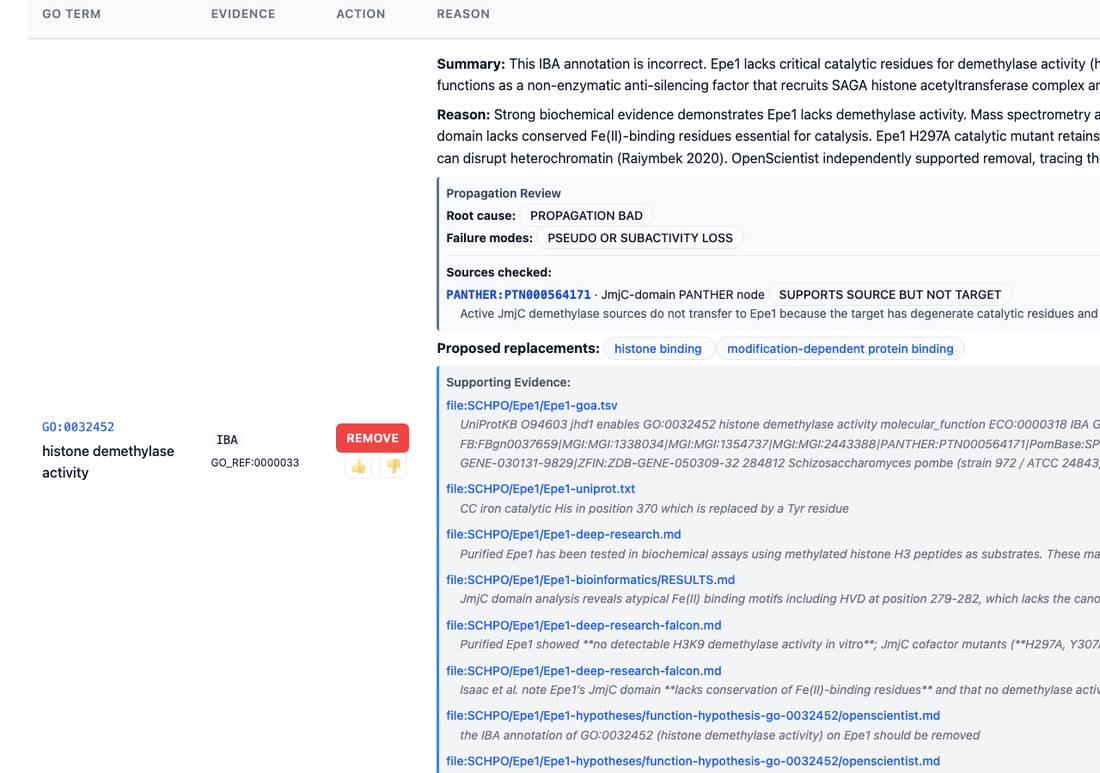
Epe1 review: IBA histone demethylase activity is REMOVE, with UniProt ("iron catalytic His in position 370 ... replaced by a Tyr"), the local RESULTS.md and a blinded OpenScientist report as support.

Four analysis types, four genes

Gene Species Analysis Review outcome (verified in YAML)
Epe1 SCHPO Active site, cofactor 7 catalytic/metal rows REMOVE
PHYKPL human Substrate specificity IEA transaminase activity REMOVE
LPL1 CANAL Localization signal IEA membrane REMOVE; lipid droplet kept
AcrF8 BPZF4 Domain architecture no analysis folder

Only Epe1 has a scripted -bioinformatics/ folder; PHYKPL and LPL1 were argued in the review text.

What we learned

  1. Active-site validation is the highest-yield check: one missing ligand can retire a whole block of IEA/IBA enzyme rows.
  2. The first Epe1 script flagged "HVD", which actually fits HxD. The real defect, Y370 at the third ligand, came from a later blinded OpenScientist run and matches UniProt.
  3. Early ad-hoc scripts were heuristic. The pmp20 workflow (see BIOINFORMATICS) is now the template: active controls, tested on a second target.

Status and next steps

  • Catalogue frozen at 4 cases (Jan 2026); 237 analysis folders exist across genes/.
  • ⬜ Create PHYKPL-bioinformatics/ and LPL1-bioinformatics/ (still listed as to-do).
  • ⬜ Replace the hand table with an index generated from the folders.

Read more: projects/AD_HOC_BIOINFORMATICS.md · projects/BIOINFORMATICS.md · genes/SCHPO/Epe1/Epe1-bioinformatics/