Allergens

Know what a protein does before you knock it out

AI Gene Review · projects/ALLERGENS · 2026

Bottom line

  • Allergens are being knocked out, neutralized and engineered, yet many have no known native function.
  • We built an allergen→UniProt index, a UniProt registry worklist and an IEDB epitope ETL, then reviewed 24 genes (cat, dog, horse, cow, mouse, rat, mite, birch + Scgb1a1): 219 existing rows (0 removed, 62 over-annotated) plus 18 new.
  • The top priorities, Bet v 1, Fel d 1, Can f 1, are heavily IgE-targeted and their native role is still unknown.

Why an allergens cohort

  • CRISPR knockout of Fel d 1 genes (CH1/CH2) for hypoallergenic cats (PMID:35386981); antibody neutralization; immunotherapy.
  • Each intervention abolishes or suppresses a protein. The safety question is a gene-function question: what do we lose?
  • Allergenicity is an IgE property of a sensitized human, not an evolved function. The label only selects genes; it never changes a GO annotation.

The triage layer

Where the priorities fall

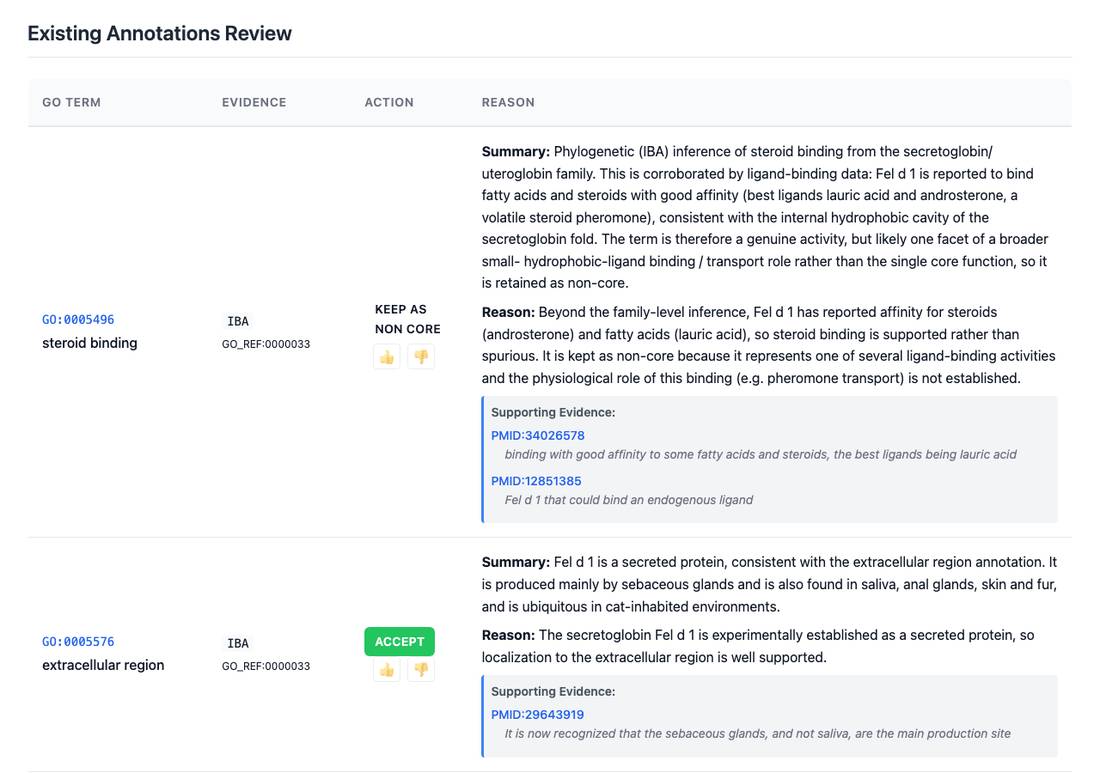
What a review looks like

Fel d 1 chain 1 (CH1): secretion accepted, IBA steroid binding kept as non-core; NEW rows add Ca²⁺ binding, LPS binding and TLR4 enhancement.

Findings

  • Fel d 1 and Der p 2 both get NEW GO:0001530 LPS binding and GO:0034145 positive regulation of TLR4 signalling: two unrelated allergens acting as auto-adjuvants.
  • Mus m 1 / Rat n 1 (MUPs): 20 over-annotated rows each, mostly ISS metabolic and insulin-signalling terms.
  • Bet v 1: ABA-receptor, phosphatase-inhibitor and signalling-receptor rows marked over-annotated (fold-based IEA).
  • Der p 23: GOA's NOT chitin binding (IDA) accepted; the peritrophin-like domain does not bind chitin.

Status and next steps

  • ✅ 24 gene reviews (all DRAFT); index 32 genes / 31 molecules; IEDB axis live.
  • ⬜ Registry coverage is small: 6 of 1,020 reviewed UniProt allergen entries when last counted; 1,014 on the worklist.
  • ⬜ Extend the IEDB name-join to protein-name-labelled allergens (human Hom s …).
  • ⬜ Continue the backlog by priority: pollens, foods, molds, insects.

Read more: projects/ALLERGENS.md · projects/ALLERGENS/allergen_index.tsv