Peroxisome biogenesis

Reviewing GO annotations for the 16 human PEX genes

AI Gene Review · projects/PEROXISOME · 2026

Bottom line

  • Peroxins insert membrane proteins, import matrix enzymes and divide the organelle; their loss causes Zellweger spectrum disorders.
  • We reviewed all 828 GO annotations on the 16 human PEX genes: 579 accepted, 93 over-annotated, 64 removed, 11 NEW.
  • The main problem was generic protein binding: 35 of PEX19's 37 removals and 17 of PEX5's 19 over-annotations.

The machinery we reviewed

Why peroxins

  • A closed, well-characterized set: 16 genes, one organelle, a clinical readout (PEX1 alone accounts for about 65% of Zellweger cases).
  • Each peroxin has one job in a cycle, which makes over-annotation easy to spot:
    • guilt by cargo: a receptor annotated to the metabolism of the enzymes it imports (PEX7 → ether lipid biosynthesis)
    • guilt by phenotype: knockout effects such as neuron migration or suckling behaviour (PEX13)
    • interactome rows: protein binding IPI from high-throughput screens

Actions per gene

What a review looks like

PEX19 review page: peroxisomal membrane and mPTS binding are accepted as core. Most of PEX19's 81 rows are protein binding IPI, and 35 of those were removed.

Findings

  1. protein binding (GO:0005515) is the largest single category of change across the set.
  2. PEX7 homodimerization (GO:0042803) marked over-annotated: the cited paper shows the WD40 repeats bind PTS2, not a dimer interface.
  3. PEX2 Cdc73/Paf1 complex and cell-proliferation phenotype rows removed.
  4. PEX14 β-tubulin binding kept as core; phase separation noted as an emerging model for the import pore.
  5. Cargo and phenotype processes mostly kept as non-core, not removed.

The peroxisome lifecycle module

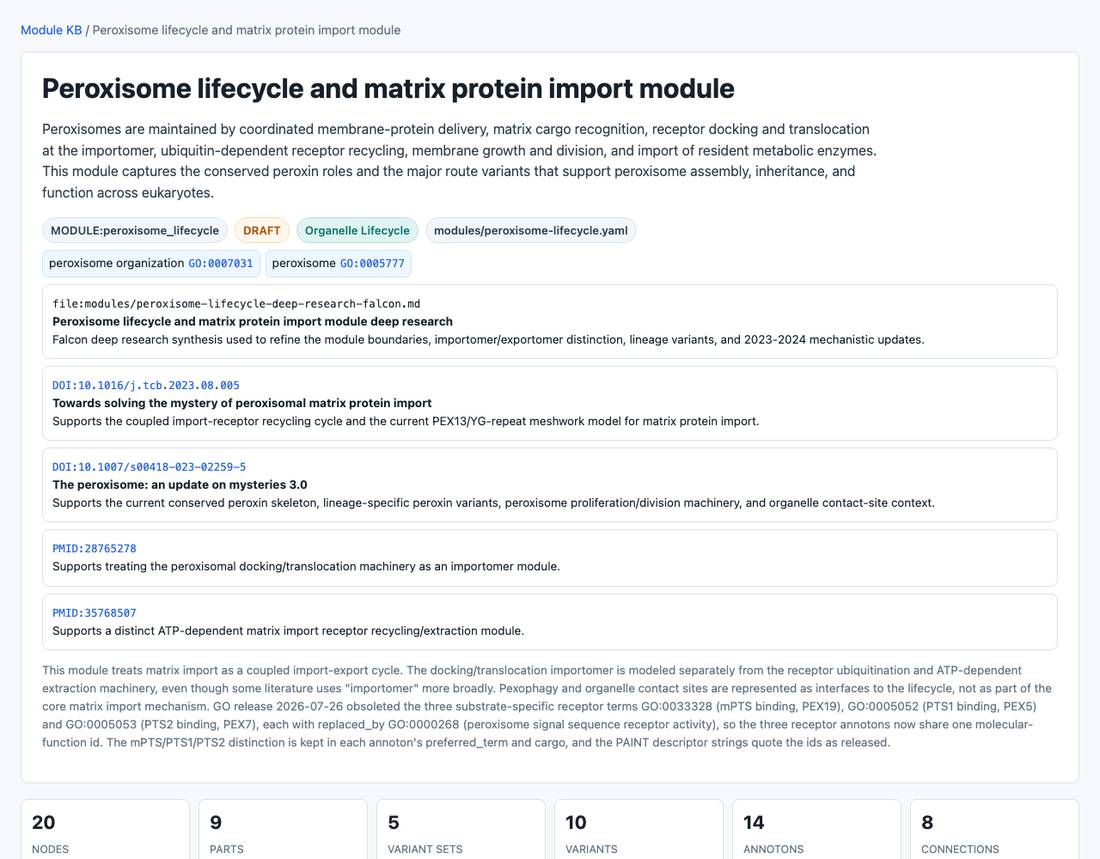
modules/peroxisome-lifecycle.yaml: membrane insertion, docking, ubiquitination, ATP-driven receptor export and division as separate parts.

Status and next steps

  • ✅ 16/16 peroxins reviewed in three phases.
  • ✅ Lifecycle module models the conserved peroxin roles and route variants.
  • ⬜ GO obsoleted the PTS1, PTS2 and mPTS binding terms in favour of peroxisome signal sequence receptor activity; PEX5, PEX7 and PEX19 reviews are tracked in projects/PEROXISOME_TARGETING_SIGNAL_OBSOLETION.md.
  • Candidates beyond scope: PEX5L, PEX39, the metabolic enzymes of the matrix.

Read more: projects/PEROXISOME.md · modules/peroxisome-lifecycle.yaml