Pathway satisfiability
Bottom line: pathway-completeness tools ask whether a genome encodes a
pathway, which is the wrong question for a metazoan, where every cell carries
the whole genome and what varies is which isozyme is expressed where. We built
an engine that reads a curation module as a boolean formula over its steps and
evaluates it against a context oracle: GTEx tissue expression, a liver
zonation atlas, or KEGG genome content. Run on the human gluconeogenesis
module across 54 GTEx tissues, it recovers exactly liver, kidney cortex and
small intestine, with every other tissue failing at the same G6PC1 step; in
the liver it confines the route to the periportal zone. The same engine
reproduces GapMind-style methionine reconstruction across eight microbial
genomes, and crossing its gaps with independent activity data yields
gene-localised leads (intestinal gluconeogenesis → G6PC1, liver ketolysis →
OXCT1, methionine "dark matter" in Synechocystis and M. jannaschii). The
engine lives in src/ai_gene_review/module_logic.py with tests; the context
resolvers are still in modules/experimental/, and a spin-off
taxon-absent-component detector
applies the same logic to flag IBA over-propagation (JAK-STAT in
Dictyostelium).
We did this because a gap between "the pathway is known to run here" and "the
logic says it cannot" is a reviewable hypothesis that points at one gene in
one context, which is the form a curator can act on.
Headline results
- It recovers textbook biology from data alone. Across GTEx's 54 tissues the human
gluconeogenesis module lights up in exactly liver, kidney cortex, small intestine — no
false positives, no misses — and every other tissue fails at the same gate step
(gluconeogenic glucose-6-phosphatase), resisting the ubiquitous non-gluconeogenic paralog. - It resolves within an organ, not just between organs. With a liver-zonation oracle the
route is satisfiable at the periportal pole and blocked at the pericentral pole — the
metazoan question ("which isozyme, in which context") that genome-level tools can't ask. - One engine, many contexts. The same logic reconstructs L-methionine biosynthesis across
microbial genomes from KEGG orthologs (picking the encoded route per organism), i.e. it
reproduces GapMind-style step-finding as a special case. - A gap is a hypothesis, not just a hole. Crossing satisfiability with an independent
activity claim turns unexplained gaps into structured leads: intestinal gluconeogenesis →
G6PC1, liver ketolysis → OXCT1/SCOT, plus microbial "metabolic dark matter" targets
(Synechocystis, M. jannaschii) that make methionine with no canonical enzyme for a step.
Why this matters: pathway-completeness tools (KEGG/Reactome coverage) ask a genome-level
question — right for a microbe, wrong for a metazoan, where every cell carries the whole
genome and the discriminating variable is which isozyme is expressed in which context.
Gluconeogenesis is "present" in every human cell, yet glucose output is restricted to a few
tissues and, within the liver, to a few cell layers. This project resolves the pathway into
that context.
How it works (model, engine,
srcpaths, and commands to reproduce every result) lives
in the companion notebook: Methods & reproduction.
It is the eukaryotic analogue of GapMind's prokaryotic step-finding.See it — a rendered demo snapshot shows the engine's
output: the compiled routes/gate, the 54-tissue GTEx resolution, and the microbial methionine
reconstruction. It is a static page (the expression-gate slider is frozen at its default). For
the live slider, run the self-contained notebook locally —
uvx marimo run projects/PATHWAY_SATISFIABILITY/demo_standalone.py— which executes offline
against committed GTEx/KEGG caches.demo_standalone.py(generated by
build_standalone_demo.py) is import-free,
so it also exports to an interactive WebAssembly page viamarimo export html-wasm.
Background: pathway hole filling
"Pathway hole filling" — a pathway looks like it should run but a step has no gene assigned, so
what fills it? — is a mature field for microbial genomes and essentially silent on the
metazoan version of the question. The prior art splits into three problems: (1) step-finding,
does a genome encode the pathway (GapMind — of which this project is the eukaryotic analogue;
KEGG module completeness; MinPath; SEED subsystems); (2) hole-filling proper, nominate the
gene for a known-but-unassigned step — the origin of the term, in Pathway Tools' Bayesian
Pathway Hole Filler (Green & Karp 2004) and IMG's "Find Candidate Genes for Missing
Function," both leaning on genome context (operons, occurrence profiles); and (3) network
gap-filling, add reactions so a flux model balances (GapFind/GapFill, ModelSEED, gapseq).
Every one of these answers a genome-level presence/absence question — right for a microbe,
where a genome roughly is an organism. It is the wrong question for a metazoan, where every
cell carries the whole genome and the discriminating variable is not presence but which
isozyme is expressed where. This project keeps GapMind's logic and swaps the oracle from
genome gene-content to context expression, so a "hole" becomes "this pathway cannot be wired
up in this context, and here is the gene and place where it fails."
Full landscape, citations, and a comparison table:
Background: pathway hole filling.
Results
Between organs (GTEx bulk tissue)
Evaluating the human gluconeogenesis module across 54 tissues recovers exactly the textbook
gluconeogenic set — liver, kidney cortex, small intestine — with no false positives and
no misses (Figure 1). Every non-gluconeogenic tissue fails at the same gate atom, the
gluconeogenic glucose-6-phosphatase catalytic subunit G6PC1, and the engine resists the
ubiquitous paralog G6PC3 (expressed everywhere but not gluconeogenic). The gate is graded:
raising the expression threshold drops tissues in the order liver → kidney → intestine, matching
their known quantitative contribution.
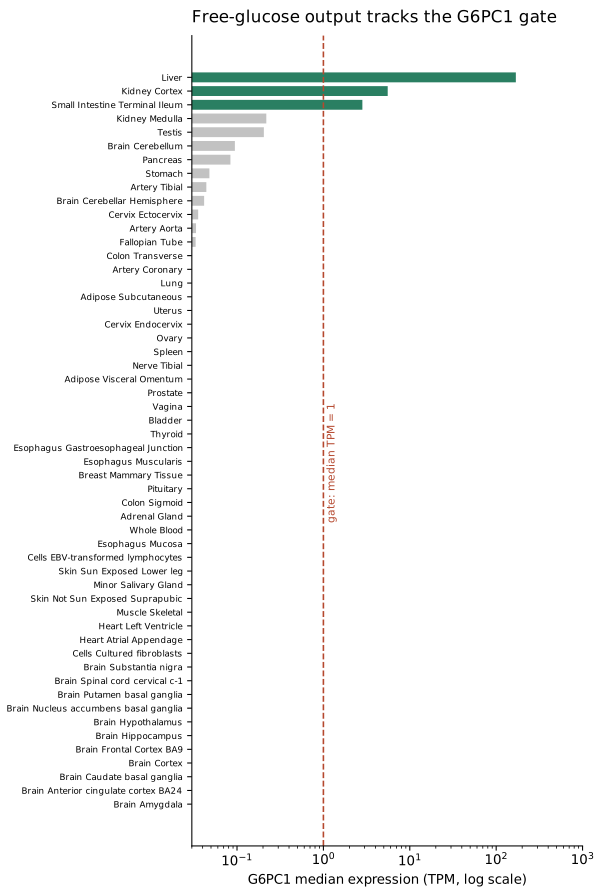
Figure 1. Across all 54 GTEx tissues: median expression of G6PC1, the terminal gate gene, on a
log axis. Green = tissues where the whole gluconeogenesis module is satisfiable — exactly the
three that clear the gate threshold (dashed line). Every grey tissue fails at that same step, and
the near-ubiquitous look-alike G6PC3 is correctly not accepted for it. Colouring is derived from
the satisfiability engine, not annotated by hand.
Within an organ (Halpern 2017 liver zonation)
Reusing the same engine with a liver-lobule zonation oracle, the gluconeogenesis route is
satisfiable only toward the periportal pole and is blocked at the pericentral pole —
at the same gate atom (Figures 2–3). The porto-central orientation is inferred from landmark genes
(not assumed), so the periportal restriction is a derivation, not a restatement.
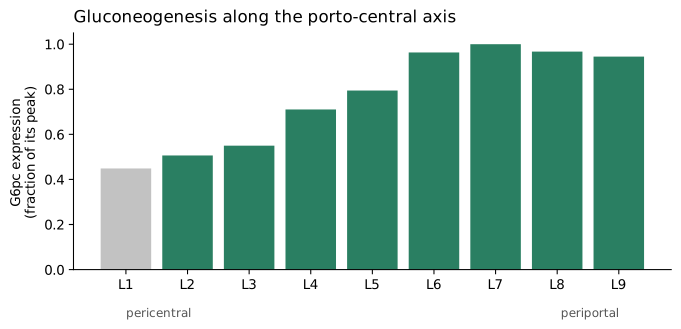
Figure 2. The measured axis. G6pc expression across Halpern 2017's nine porto-central zonation
layers (L1 pericentral → L9 periportal), each bar coloured by whether gluconeogenesis is
satisfiable there. The pericentral layer is blocked at the very same gate atom, G6PC1, that
separates organs in Figure 1. This is a one-dimensional measurement — expression along a single
axis, not a tissue image.
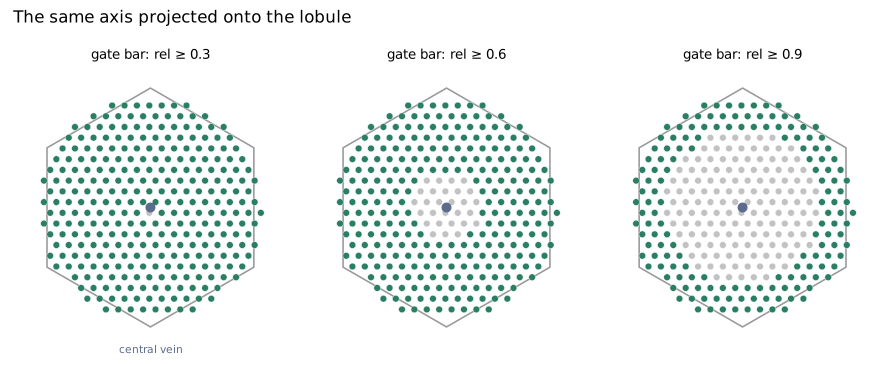
Figure 3. The same axis projected onto the lobule. Figure 2's nine layers are wrapped onto the
canonical lobule diagram (central vein at the centre, portal rim outside) and tiled as
spots; as the expression gate tightens (left → right) the satisfiable zone (green) retreats to
the periportal rim. The geometry is a schematic — a standard anatomical diagram, not measured
2-D coordinates — while each spot's colour is the real per-layer result from Figure 2.
Which precursor? (substrate-entry routes)
A precursor-resolved module makes lactate / alanine (via pyruvate) and glycerol (bypassing
the carboxylation backbone) explicit. Because glycerol skips that backbone, the only
universally required step is the terminal glucose-6-phosphatase system. Per tissue the engine
then reports which precursors are usable, with physiologically faithful skews (kidney
lactate-dominant; liver highest alanine capacity).
Across genomes (KEGG genome presence) — the GapMind reproduction
The same engine reconstructs L-methionine biosynthesis from KEGG orthologs across genomes
(Figure 4). It selects the encoded route per organism (succinyl vs acetyl acylation;
trans-sulfuration vs direct sulfhydrylation; cobalamin-dependent vs -independent methylation),
completes C. glutamicum through the alternative branch despite a missing trans-sulfuration
enzyme, and flags genome-reduced organisms as gaps.
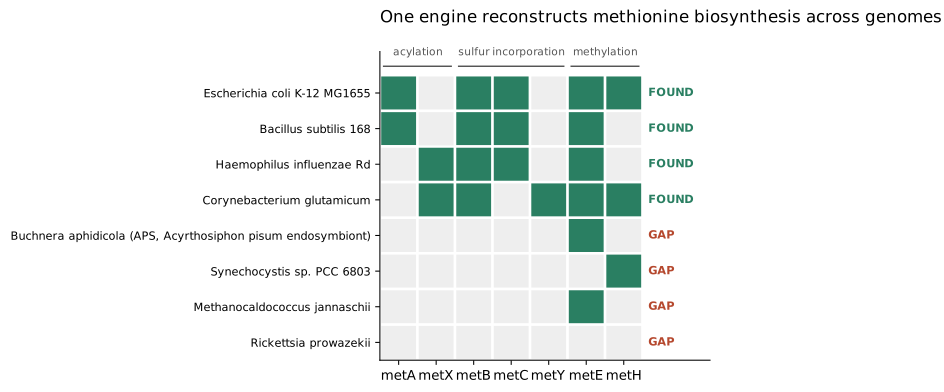
Figure 4. Methionine biosynthesis reconstructed across eight genomes. Green = the ortholog is
encoded (KEGG); columns are grouped by pathway stage (acylation metA/metX; sulfur
incorporation metB+metC trans-sulfuration or metY direct; methylation metE/metH). Each
genome uses a different encoded route — E. coli succinyl (metA), H. influenzae acetyl
(metX), C. glutamicum direct sulfhydrylation (metY, no metC) — and the engine reports
FOUND or a GAP accordingly. Only the oracle changed from the tissue results; the logic is
identical.
Abduction — a gap is a hypothesis
Crossing satisfiability with an independent activity phenotype (Figure 5):
| outcome | meaning | example |
|---|---|---|
| CONSISTENT_ACTIVE | reconstructable & known prototroph | E. coli, B. subtilis, C. glutamicum |
| ABDUCTION_TARGET | makes methionine but a step has no candidate | Synechocystis, M. jannaschii |
| CONSISTENT_INACTIVE | gap correctly predicts a known auxotrophy | Rickettsia prowazekii |
The two abduction targets are real metabolic dark matter: both are autotrophs that synthesise
methionine yet encode none of the canonical acylation/sulfur enzymes, so the engine emits a
structured lead ("an unannotated / non-orthologous enzyme must fill this step"). The same
machinery does not over-call Rickettsia, whose gap is correctly read as its auxotrophy.
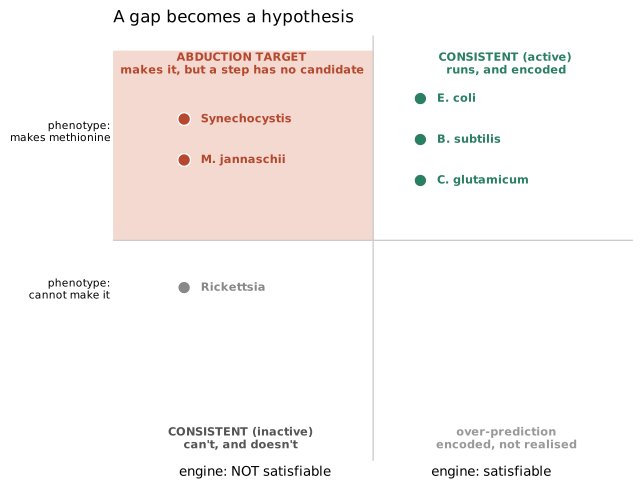
Figure 5. A gap becomes a hypothesis. Each genome placed by the engine's verdict (can the
pathway be reconstructed? — horizontal) against an independent phenotype (does the organism
actually make methionine? — vertical). The dangerous, interesting quadrant is top-left: organisms
that demonstrably make methionine yet have no candidate for a step — Synechocystis,
M. jannaschii — flagged as leads. Rickettsia (a genuine auxotroph) is correctly not flagged,
and the "encoded but not realised" quadrant is empty. The phenotype axis is independent of the
gene content, so a flagged gap is a real prediction, not a restatement.
The same abduce() runs on the eukaryotic side against GTEx, with the independent claim
now a documented tissue function (and an extra "not cell-autonomous" explanation, since a
metazoan pathway can be split across organs):
| outcome | meaning | example |
|---|---|---|
| CONSISTENT_ACTIVE | tissue oxidises ketones, enzymes expressed | heart, brain, muscle, kidney |
| CONSISTENT_INACTIVE | gap correctly predicts the function's absence | liver ketolysis → gap at OXCT1/SCOT |
| ABDUCTION_TARGET | function reported but a step's gene barely expressed | intestinal gluconeogenesis → G6PC1 |
Ketone-body oxidation pinpoints why the liver cannot consume the ketones it makes — it is the
one tissue lacking OXCT1/SCOT (GTEx liver = 0 TPM) — reproducing a textbook fact from
expression alone. Intestinal gluconeogenesis, genuinely debated because intestinal
glucose-6-phosphatase is low, surfaces as a lead localised to one gene, which is exactly the
form a reviewer can act on.
Epistemics
- Presence ≠ flux. Expression/genome presence is used asymmetrically: absence excludes a
route (strong), presence only permits it. A satisfiable set is an upper bound on capacity. - Derived, not assumed. Zonation orientation comes from landmark genes; tissue/zone
identity from data — never from the answer being sought. - Abduction is independent. The activity column (growth phenotype) is independent of the
ortholog oracle, so a scored gap is a genuine prediction, and "the assertion is wrong" is
always retained as an explicit hypothesis.
Methods & reproduction
The model, engine internals (module_logic.py), architecture diagram, source paths, and the
exact commands to reproduce every result above are in the companion notebook:
Methods & reproduction.
Next steps
- A human liver zonation oracle to remove the mouse-ortholog step in the zonation result.
- Apply the engine to additional curated modules (it is module-agnostic).
- Promote the resolvers from
modules/experimental/into a small CLI once the oracle
interfaces stabilise.
Slides
- Slides (Marp source: PATHWAY_SATISFIABILITY-slides.md) — AI generated