BioReason-Pro Comparison Project
Bottom line: BioReason-Pro (Fallahpour et al. 2026,
doi:10.64898/2026.03.19.712954) is a
reasoning LLM that turns GO-GPT term predictions, InterPro domains and organism
context into a written functional summary. We collected its web reports for 139
genes from 14 organisms (ARGO139) and had an agent score each summary against
our local gene review, then assessed every SFT GO-term prediction for a 95-gene
subset (ARGO95) with the COR/CNN/LSP/UNC/PLI/NPI/REP taxonomy. As of the review
snapshot (2026-09-27, commit c7551cb3db), mean correctness on the 138-gene
performance set is 4.0/5 but completeness only 2.9/5, and most summaries restate
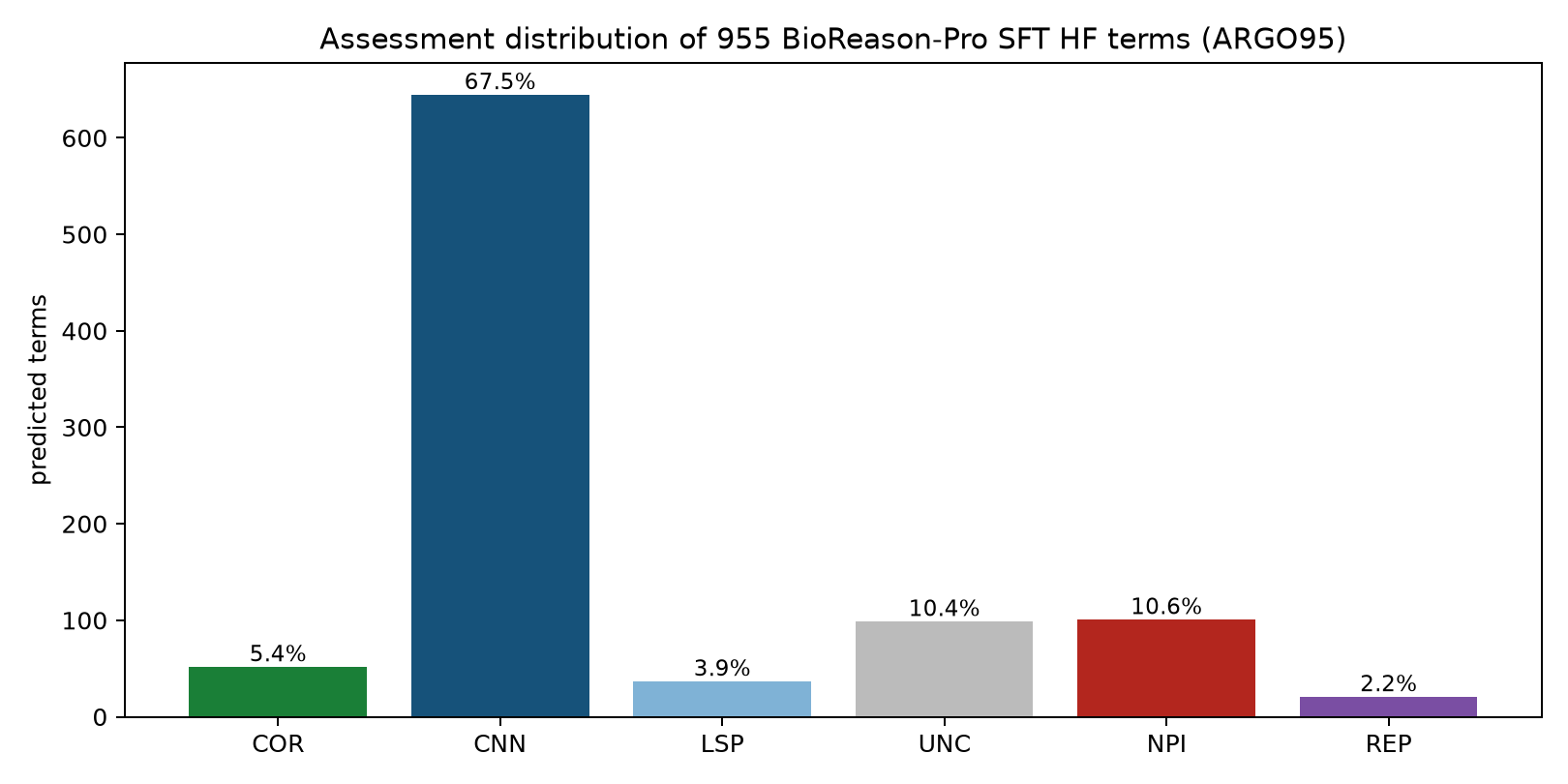
what InterPro domain labels already say. Of the 955 SFT terms, 682 were correct
but already known and only 23 were correct novel predictions. The model fails
systematically on localization, pseudoenzymes, paralogs and organism-specific
biology. The GO-GPT leaf-term review of ARGO139 is still a draft workspace.
We did this to answer the question a database curator actually faces: are a new
method's predictions good enough to import, and where do they break? The work was
presented at ISMB 2026 and is written up as a manuscript.
Function prediction evaluation index
Browse BioReason comparison predictions — filter SFT and GO-GPT term predictions alongside RL narrative reviews, with each assessment scheme kept explicit.
Where the numbers are. Per-category and per-organism counts live in the
prediction browser rather than in this page; the facet counts are the tables.
- RL narrative scores, performance set — correctness and completeness distributions, with a species facet for the per-organism breakdown.
- ARGO95 SFT term assessments — the assessment and error-type facets give the full category split.
- Supplemental SFT term cohorts and HF SFT narrative reviews.
- GO-GPT leaf claims (ARGO139) — the pending review, including unresolved
UNCterms. - GO-GPT three-level overlap — each specific GO-GPT term for 296 genes, flagged by whether it appears in raw GOA, in the post-review AIGR annotations, and in the AIGR core functions; for example, terms matching an AIGR core function.
The overlap view is fixed at the review snapshot and matches the manuscript. The
set and claim views read the current reviews, so their counts can move ahead of
the dated figures, which are recorded in benchmark-metrics.json.
📄 Read the manuscript (PDF) · 🖥 View the slide deck · 📝 Abstract
🎤 Presented at ISMB 2026 (Function COSI, Washington DC, 14 July 2026): Caufield JH, Joachimiak MP, Mungall CJ. Agentic evaluation of AI function prediction pipelines. Slides archived at doi:10.5281/zenodo.21810552
Explore the evaluations interactively:
- BioReason-Pro SFT evaluation — ARGO95 primary cohort: 95 genes, 955 predictions; the browser also includes supplemental source cohorts
- GO-GPT leaf evaluation — ARGO139 collected cohort; unresolved terms are explicitly pending
- GO-GPT leaf adjudication (OpenScientist) — expert overlay: 7 specific-MF calls blind-tested; 0/7 novel-correct — GO-GPT mirrors GOA
- DeepECTF evaluation (ESR-ECOLI-DET-Mini) — 7 E. coli genes
Data, benchmarks, and reproducibility
- Benchmarks.
genes.csvis ARGO139 (Annotation Review GO), the fixed 139-gene collected cohort used for RL narrative review. ARGO95 is the 95-gene subset with HuggingFacewanglab/protein_catalogueSFT GO-term predictions, used for the primary SFT term review. The benchmark policy freezes the audit baseline and scoring rules. Composition and provenance are recorded in species counts, curation-context counts, cohorts, per-gene sources, input/reference quality and checksums, the authoritative generated metrics, and the benchmark supplement. - ESR-ECOLI-DET-Mini (recap experiment): a 7-gene quick-check recap of the de Crécy-Lagard expert review of DeepECTransformer predictions. Dataset
10.5281/zenodo.20751016.ESR-ECOLI-DET-7is a count-explicit alias. - Reproducible stats notebooks (
notebooks/) recompute the summary statistics below directly from the committed per-gene files, with no hard-coded numbers.
Methods
We downloaded the reports for selected genes from https://app.bioreason.net/ (there is no API yet so this cannot be done in bulk). We assigned an AI agent to compare them with existing pipelines (for example, InterPro2GO) and with the agent-adjudicated local AIGR reference. These local references have mixed review maturity and are not independently expert-signed ground truth.
Notes on browsing results
Each individual gene review page, e.g. aprE, SlyD contains BOTH the bioreason results AND the detailed review of the bioreason results. You will need to search in the page for "bioreason" or scroll down to the sections:
- Deep Research Bioreason RL (we treat the bioreason outputs as a kind of preliminary research)
- Bioreason RL review
Key findings (139 RL reviews)
-
BioReason largely recapitulates InterPro labels in narrative form. For most genes, the functional summary does not provide biological insight beyond what InterPro domain annotations already capture. Genuine value-add is modest and concentrated in proteins with distinctive, well-annotated domain architectures such as TOR1 (FRB domain enables pathway-level inference), PTEN, NOTCH1, and EGFR. For standard domain families like Src-family kinases, Fyn and Src receive essentially identical generic descriptions.
-
Systematic localization errors. BioReason defaults to "cytosolic" or "cytoplasmic" when no transmembrane domains are detected, failing for periplasmic proteins (Skp, CpxP, Spy), vacuolar proteins (cps1), mitochondrial matrix proteins (alo1, HSP60, CAT2), and ER membrane proteins (IRE1, ETR1). Proteins where InterPro domain names explicitly mention the compartment (KAR2, PDI1) are handled correctly.
-
Pseudo-enzymes are a blind spot. BioReason assumes catalytic activity from conserved but degenerate domains and cannot reliably identify inactive family members. Epe1 (pseudo-demethylase), cts2 (pseudo-chitinase missing catalytic glutamate), and pmp20 (a 1-Cys peroxiredoxin-family protein with an intact peroxidatic cysteine but directly assayed as peroxidase-inactive and functioning as a chaperone) are all incorrectly assigned ancestral enzymatic activity.
-
Paralogs get identical generic descriptions. Closely related paralogs such as Fyn/Src (mouse), sigF/sigG/sigK (B. subtilis sporulation sigma factors), and Hspa5/Hspa8 (rat Hsp70 family) receive interchangeable summaries with no gene-specific biology.
-
Organism-specific biology is consistently absent. Dauer formation and insulin/IGF-1 signaling in C. elegans (daf-16, daf-2), UPRmt master regulation (atfs-1), sporulation compartment specificity in B. subtilis (sigF forespore, sigK mother cell), prion propagation in yeast (HSP104), and cytoophidium biology (ura7) are all missed.
-
Selected-case organism means differ. Mouse scores highest on descriptive correctness and the selected S. pombe cases lowest among the organism groups with at least three genes; two single-gene groups score lower (select a species in the RL narrative view). These differences are confounded by deliberate case selection: S. pombe is enriched for obscure proteins and pseudoenzymes, whereas several other groups contain more canonical proteins. InterPro informativeness and training distribution are hypotheses, not measured explanations.
Only one gene, rat Uggt1, scored 5/5 on both axes.
Background
Architecture:
- GO-GPT: autoregressive transformer (ESM2 embeddings + organism -> GO terms). Upstream predictor.
- BioReason-Pro: Qwen3-based multimodal reasoning LLM. Takes GO-GPT predictions + InterPro + PPI + organism context -> chain-of-thought reasoning trace + functional summary. Two variants: SFT (richer mechanistic depth) and RL (fewer hallucinations).
The GO term list in web exports is raw GO-GPT output (input to reasoning). BioReason-Pro produces its own GO terms after the reasoning step, but the current web app does not separately expose these.
Web app: app.bioreason.net | Code: bowang-lab/BioReason-Pro | Models: HuggingFace wanglab collection
Data
Per gene, the following files are available (example: ECOLI/SlyD):
| File | Description |
|---|---|
{GENE}-bioreason-rl-predictions.md |
Raw BioReason-Pro RL web export (reasoning trace, functional summary, InterPro, GO-GPT terms) |
{GENE}-bioreason-rl-review.md |
Evaluation of the Functional Summary (correctness/completeness scores + InterPro domain-label comparison and, where present, InterPro2GO comparison) |
{GENE}-gogpt-leaf-predictions.yaml |
GO-GPT leaf terms as PredictionReview YAML |
{GENE}-sft-predictions.yaml |
BioReason-Pro SFT GO terms as PredictionReview YAML |
{GENE}-ai-review.yaml |
Agent-adjudicated local AIGR reference; completion status is recorded in benchmark-quality.csv |
Evaluation rubric
Correctness (1-5)
- 5: All material claims are supported; no substantive factual error
- 4: Core function is correct with one limited secondary error or overstatement
- 3: Core function is correct, but one or more substantive claims are wrong
- 2: Some relevant biology is present, but errors materially distort the function
- 1: Fundamental mischaracterization or predominantly unsupported account
Completeness (1-5)
- 5: Covers established core functions, locations, complexes, and pathway context
- 4: Covers the core function and most major context, with a limited omission
- 3: Gets the basics but misses significant established biology
- 2: Captures only one important facet or remains substantially incomplete
- 1: Superficial, one-dimensional, or misses the core function
Correctness is scored only on claims the model makes; missing biology lowers completeness, not correctness. Each review also assesses whether the narrative adds information beyond InterPro domain/family labels. Only 92/139 genes have an actual GO_REF:0000002 annotation in the committed GOA snapshot, so this qualitative domain-label comparison is not described as a universal InterPro2GO control.
Benchmark integrity audit
ARGO139 names the collected cohort (139 exports), not an unconditional model-performance denominator. The current policy excludes worm/csr-1 from model scoring because the export was generated from nhr-47/Q17370 rather than CSR-1. Seven otherwise retained exports are exact 2,000-residue prefixes of longer UniProt sequences (Dscam1, BRCA2, HTT, LRRK2, human and mouse NOTCH1, and TOR1) and are stratified as TRUNCATED_AT_MODEL_LIMIT.
The local AIGR references are also not represented as independently expert-signed ground truth: as of the review snapshot (2026-09-27, commit c7551cb3db), 79 are COMPLETE, 45 DRAFT, 11 IN_PROGRESS, and 4 INITIALIZED. benchmark-quality.csv records this status plus export/accession, sequence lengths, GOA dates, raw-export checksums, and separate counts/checksums for the InterPro and upstream GO-GPT sections. All 139 exports contain the GO-GPT section; three lack an InterPro section (Shu1, atg16, and pgl-1). Publication-facing analyses must disclose the reference-status and input-quality strata.
Dated snapshot. Numbers derived from the live AIGR reviews and SFT prediction assessments (the GO-GPT three-level overlap, the sidecars' reference statuses, checksums and ARGO95 assessment counts, the CAFA-style scores and NPI/PLI/REP GOA-overlap counts in cafa-style/, the second-review agreement, and the ProtNLM cross-cohort summary) are computed from the repository at review_snapshot_commit in benchmark-policy.yaml, not from the working tree, so ordinary curation — including recoding a *-sft-predictions.yaml assessment — does not change them. Tests that only check live files are well-formed (every narrative review has two in-range scores; no deterministic category conflicts; FREQUENCY_BIAS only on REP) still read the working tree and pin no numbers. The frozen ARGO95/ARGO139 GOA inputs stay pinned separately at baseline_commit. A refresh is deliberate: just refresh-benchmark-snapshot [COMMIT] (default origin/main) bumps the snapshot, regenerates every derived file, and prints which headline numbers moved; then update the pinned test numbers and the "as of" dates, and review the diff.
The two rubric axes remain correlated, so they should not be read as statistically independent merely because the rubric defines different concepts. A blinded second rater scored a deterministic 20-gene subset balanced across first-rater correctness strata and agreed closely on correctness (quadratic-weighted kappa 0.95) and less well on completeness (kappa 0.74). Raw ratings and the generated agreement metrics, including exact and within-one agreement, are committed.
Most ARGO95 CNN calls are exact matches to the frozen GOA input; the rest are supported as non-novel by other established local evidence. The claims view gives the category split. A frozen-ontology ID/label adjudication re-examined mismatched or unresolved raw pairs that were nonnegative either at the audit baseline or after manual biological reclassification, and changed most of them after separating ontology status from the biological rubric and assessing the canonical GO concept rather than an intended but incompatible label. Raw model pairs remain unchanged and are explicitly flagged in their review rationales. DnaK zinc ion binding (GO:0008270) moved from NPI to CNN during comprehensive review because PMID:11985624 directly identifies DnaK in a radioactive Zn(II)-binding screen and the term was already present in GOA as an IDA annotation; the observation remains non-core because its physiological relevance and binding mechanism are unresolved. The IRE1 nucleus prediction (GO:0005634) was also corrected from NPI to CNN after the gene review retained its existing IDA annotation (PMID:17035634) as KEEP_AS_NON_CORE; this reconciles the prediction assessment with the current review without making nuclear localization the core cellular location.
Annotation suitability and prediction correctness are distinct judgments. The rat/Casp3 death-receptor-binding prediction is now UNC: PMID:17518537 supports DISC association, while the accessible evidence does not settle direct receptor contact. Rat Uggt1's unfolded-protein-binding prediction remains CNN because the reference review and PMID:10764828 affirm non-native glycoprotein recognition; preferring a glucosyltransferase activity annotation does not refute that binding concept. Both decisions are explicit gene/term adjudications scoped to MARK_AS_OVER_ANNOTATED, with stronger rejection or negation requiring renewed review.
The ontology authority for this audit is the official archived 2026-03-25 go-basic.obo, pinned by SHA-256 in benchmark-policy.yaml and checked at load time with both obsolete and active sentinel terms. That release, and the current GO API, explicitly mark terms such as GO:0005615 extracellular space and GO:0005844 polysome obsolete. Committed GOA snapshots can lag those obsoletions, and the mixed-date legacy cache/ontologies/go.tsv flag is not used for benchmark adjudication.
The external-authority verification independently downloads the official archive and queries both QuickGO and OLS. On 2026-07-12, the remote archive matched the pinned SHA-256, and both services returned all five disputed sentinels as obsolete; OLS additionally states that GO:0005615 duplicates GO:0005576. Ontology status is reported separately from the seven biological assessment categories: obsoletion alone does not turn a correct non-novel prediction into LSP. LSP remains reserved for a supplied ID whose canonical concept is more generic than the supported annotation. This distinction restores status-only cases such as DROME/LysB and BACSU/aprE GO:0005615 to CNN while retaining the obsolete-ID warning.
The ARGO139 GO-GPT files were rebuilt from raw web exports with ontology-aware leaf pruning. Most of the cleaned terms are either CNN or still-unresolved UNC, and nearly every document remains DRAFT; only BACSU/ftsZ and SCHPO/ral2 are fully resolved. This is a transparent pending review, not a completed GO-GPT performance result; the GO-GPT leaf claims show its current state.
Results (138-gene performance set; 139 collected exports)
About half of the performance set scored 5/5 on correctness, while almost none
reached 5/5 on completeness; the typical summary gets the core function right and
leaves out established context. The score distributions are the facet counts in
the RL narrative view; select a species to see that organism's distribution.
Top performers (correctness 5/5)
| Gene | Organism | Completeness | Why it works |
|---|---|---|---|
| Uggt1 | rat | 5 | ER quality control enzyme with highly informative domain names |
| TP53 | human | 4 | Distinctive TAD-DBD-tetramerization architecture |
| PTEN | human | 4 | Dual-specificity phosphatase domains are unambiguous |
| EGFR | human | 4 | Canonical RTK architecture well-represented in InterPro |
| NOTCH1 | human | 4 | Proteolytic cascade well-encoded in domain layout |
| MYC | human | 4 | bHLH-LZ domains directly predict E-box binding |
| Akt1 | mouse | 4 | PH + AGC kinase architecture is diagnostic |
| Calm1 | mouse | 4 | EF-hand domains immediately predict calcium sensing |
| Pten | mouse | 4 | Same as human PTEN |
| Trp53 | mouse | 4 | Same as human TP53 |
| ftsZ | BACSU | 4 | Tubulin-like GTPase domain is highly specific |
| spo0A | BACSU | 4 | Response regulator + DNA-binding domains clearly predict phosphorelay TF |
| GroEL | ECOLI | 4 | Chaperonin domains are unambiguous |
| lgg-1 | worm | 4 | Atg8/ubiquitin-like fold directly predicts autophagy adaptor |
| bst1 | SCHPO | 3 | GPI inositol-deacylase function nailed from specific family annotation |
Critical failures (correctness 1/5)
| Gene | Organism | Completeness | Failure mode |
|---|---|---|---|
| atg16 | SCHPO | 1 | No InterPro domains available; confabulated carbohydrate metabolism |
| Epe1 | SCHPO | 1 | Degenerate JmjC pseudoenzyme described as an active histone demethylase |
| pmp20 | SCHPO | 2 | Neo-functionalized peroxiredoxin -> chaperone; model assumes ancestral function |
| pol5 | SCHPO | 1 | Predicted cytokinesis scaffold; actual function is pre-rRNA processing and ribosome biogenesis |
| Shu1 | SCHPO | 1 | Predicted HECT ubiquitin ligase; actually a GPI-anchored heme receptor |
| tam10 | SCHPO | 1 | Unsupported essential-growth scaffold narrative invents molecular and pathway roles for a protein of unknown function |
| pgl-1 | worm | 1 | Described as nuclear TF scaffold; actually cytoplasmic P granule component |
Failure mode taxonomy
The prose failure modes below are encoded as controlled error_type values on the
discordant (NPI/PLI/REP) predictions in the per-gene *-predictions.yaml files, using the
same shared PredictionErrorTypeEnum as the ProtNLM evaluation so
the two projects are directly comparable. Four values were added for patterns Table 1 of de
Crécy-Lagard et al. does not name: PSEUDOENZYME_OVERANNOTATION (mode 1), LOCALIZATION_DEFAULT
(mode 2), TAXON_CONSTRAINT_VIOLATION (mode 7, cross-kingdom), and WRONG_INPUT_SEQUENCE
(mode 9). Paralog indistinguishability (mode 3) maps to the existing PARALOG_OVERANNOTATION
and neofunctionalization/moonlighting (mode 5) to MULTIPLE_FUNCTIONS. These tags are applied
where a predicted GO term embodies the failure; modes that are narrative-only (e.g. the model
calling a periplasmic protein "cytoplasmic" in prose while GO-GPT still predicts the periplasm
term) leave no discordant term to tag and are recorded only in the RL narrative reviews.
1. Pseudo-enzyme blind spot
BioReason assumes catalytic activity from conserved domains without checking whether catalytic residues are intact. This is a systematic failure for proteins that retain an ancestral fold but have lost enzymatic activity.
Examples:
- Epe1 (SCHPO, 1/5): BioReason claims "JmjC catalytic center dictates a lysine demethylase mechanism" but Epe1 has a degenerate Fe(II)-binding triad (H297-E299-Y370, with Tyr370 in place of the third iron-ligand His). No detectable demethylase activity in mass spec assays. Functions as anti-silencing factor through HP1/Swi6 binding.
- cts2 (SCHPO, 2/5): Called an active chitinase, but the protein lacks the essential catalytic glutamate and is likely catalytically dead.
- pmp20 (SCHPO, 1/5): Predicted as an active peroxidase, but this 1-Cys family member was directly assayed as peroxidase-inactive and functions as a molecular chaperone; absence of a resolving cysteine is not itself the mechanistic defect.
Notably, the BioReason paper highlights CFAP61 as a correctly identified pseudoenzyme, but this success does not generalize to our test set.
Independent adjudication (OpenScientist). Three predictions we had scored UNC
(genuinely on the fence) were re-tested as blinded gene-function hypotheses by an
independent OpenScientist agent (structure + comparative genomics; the suspected answer
was withheld from the prompt). Two were pseudoenzyme over-annotations, resolving the
UNC calls to NPI (full reports live under each gene's *-hypotheses/ directory):
- MJ1511 (METJA) predicted as a thiol-disulfide oxidoreductase (GO:0016671):
refuted — no CxxC redox motif, no proton-relay histidines, and its two cysteines sit
~36.5 Å apart in the AlphaFold model.
- cts2 (SCHPO) predicted to drive fungal cell-wall disassembly (GO:0031506):
refuted — GH18 catalytic glutamate replaced by asparagine (E166N); the S. japonicus
ortholog retains the intact motif.
- DCAF12L2 (human) predicted to target proteasomal degradation via CRL4 (GO:0043161):
partially supported, kept as a lead — the WD40 substrate-binding arm is intact but the
DDB1-binding interface is degenerate and DDB1 is absent from all 43 experimental interactors,
so the CRL4-assembly step is unconfirmed.
Dispute confirmation (OpenScientist). Separately, 12 SFT predictions we had disputed
(NPI/PLI) were re-tested the same blinded way to check our own rejections. Most incorrect-call
verdicts were upheld, with three important corrections. pmp20's peroxiredoxin NPI stands but the rationale
was corrected (it is a 1-Cys peroxiredoxin with an intact peroxidatic site — not a "lost resolving
cysteine" — that is nonetheless directly assayed as inactive: GOA NOT|enables glutathione
peroxidase), and SPAC8E11.10's NADP⁺-alcohol-dehydrogenase call was softened NPI → LSP (a
defensible broad activity class, less precise than its sorbose-reductase function). The
DnaJ protein-disulfide reductase activity call was corrected from NPI to CNN: the activity
has direct assay support
and the current AIGR keeps it as non-core. The remaining confirmed incorrect calls recapitulate the
same failure modes — pseudoenzyme/paralog over-annotation (LysB lysozyme≠chitinase; DnaK is not a
redox enzyme; alo1, mlcD, rdgBbeta wrong
paralog/substrate; comK/fliY misread domain labels), and wrong-input-sequence (csr-1, which
also surfaced a real accession bug: Q21992 is deleted and maps to larp-1). Full reports live under
each gene's *-hypotheses/ directory.
2. Localization defaults to cytoplasm
When InterPro annotations lack transmembrane or signal peptide information, BioReason systematically defaults to cytoplasmic localization. This fails for:
- Periplasmic proteins: Skp, CpxP, Spy (all E. coli) are called cytoplasmic despite having signal peptides.
- ER membrane proteins: ETR1 (Arabidopsis ethylene receptor) called "soluble cytoplasmic signal transducer" — actually an ER membrane integral protein with 3 TM helices. IRE1 (yeast) similarly mislocalised.
- Mitochondrial proteins: alo1 (SCHPO), HSP60 (yeast), CAT2 (yeast) all called cytosolic.
- Vacuolar proteins: cps1 (SCHPO) called cytoplasmic.
- Secreted proteins: fibrolase (AGKCO) claimed as "membrane-tethered neural/endocrine" — actually a secreted venom fibrinolytic enzyme.
Proteins succeed when InterPro domain names explicitly contain the compartment (KAR2/BiP -> ER, PDI1 -> ER).
3. Paralog indistinguishability
Closely related family members receive essentially identical descriptions:
- Fyn vs Src (mouse): Both get a generic Src-family kinase description. No mention of Fyn-specific T-cell signaling, tau phosphorylation, or myelination. No mention of Src-specific osteoclast biology.
- sigF vs sigG vs sigK (BACSU): All three sporulation sigma factors treated as generic sigma factors. The curated reviews show sigF is forespore-specific with partner-switching (SpoIIAB), sigG is late-forespore with Gin anti-sigma regulation, sigK requires processing from pro-sigK and excision of the skin element.
- Hspa5 vs Hspa8 (rat): Both described as generic Hsp70 chaperones. Hspa5 (BiP) is ER-specific with UPR regulation. Hspa8 (Hsc70) has distinctive constitutive functions in clathrin uncoating and chaperone-mediated autophagy.
4. Organism-specific biology absent
BioReason's domain-to-function reasoning cannot capture biology that is specific to a lineage or organism:
- C. elegans: daf-16 described as generic forkhead TF (misses IIS pathway, longevity, dauer biology). daf-2 described as generic RTK (misses insulin/IGF-1 receptor identity and aging). atfs-1 described as generic bZIP TF (misses UPRmt master regulator role). hlh-30 described as generic bHLH (misses TFEB ortholog identity and autophagy/lysosome biology).
- B. subtilis: Sporulation compartment specificity is never captured. aprE's role in quorum sensing/Phr peptide processing is missed. comK described via protein binding instead of competence regulation.
- S. cerevisiae: HSP104 misses prion propagation and thermotolerance. RAS2 fundamentally wrong (vesicle trafficking instead of cAMP/PKA signaling). TOR1 is the exception where FRB domain enables pathway identification.
- S. pombe: ura7 misses cytoophidium biology. pol5 completely wrong (cytokinesis scaffold instead of pre-rRNA processing/ribosome biogenesis).
5. Neo-functionalization and moonlighting
When a protein has acquired a function different from its ancestral domain prediction, BioReason defaults to the ancestral/family-typical function:
- pmp20 (SCHPO): Peroxiredoxin fold -> predicted peroxidase; actual chaperone
- Nmnat (DROME): NAD+ biosynthesis enzyme fold -> misses moonlighting chaperone/neuroprotection function
- LysB (DROME): Lysozyme fold -> framed as immune defense; actually a digestive enzyme
- GAPDH (human): Correctly identifies glycolytic enzyme but misses all moonlighting functions
- Casp3 (rat): Core protease/apoptosis correct but misses differentiation roles in neurons, keratinocytes, erythrocytes
6. Narrative-GO prediction disconnect
In multiple cases, the GO term predictions from the upstream ESM model are more accurate than BioReason's narrative functional summary. The two outputs appear to be generated somewhat independently:
- RidA (ECOLI): Narrative describes the correct chemistry ("accelerating hydrolysis of reactive intermediates") but calls it "non-enzymatic" and assigns protein binding (GO:0005515) instead of deaminase activity (GO:0019239).
- atg2 (SCHPO): GO terms include correct autophagy terms but the narrative describes only scaffolding, missing the primary lipid transfer function.
- BenR (PSEPK): GO term predictions are reasonable but the narrative describes a CO/formate regulator instead of a benzoate pathway activator.
7. Cross-kingdom fold bias
Training data skewed toward well-studied organisms can bias predictions:
- aprE (BACSU): BioReason predicts human hemostasis/blood coagulation processes for a B. subtilis subtilisin, reflecting mammalian-dominated training data.
- PGRPLB (ANOGA): Called a "fruit fly" protein when it is actually from the mosquito Anopheles gambiae.
- NFE2L2 (human): bZIP domain analysis erroneously emphasizes erythroid function (from the NF-E2 family name) over the protein's primary role in antioxidant response.
8. Generated UniProt-style summary fabrication
The export section titled UniProt Summary is generated by BioReason's instruction to summarize in UniProt format; it is not text imported from UniProt. Only 3/139 RL strings are exact substrings of the cached UniProt record. Incorrect text in this section is therefore a model-output error, not an upstream UniProt error. Clear examples include steroid-sulfate transport for Slc5a1, a protist/cytochrome-b6 context for human CYCS, and "probable glutamine amidotransferase" for PARK7.
9. Wrong input data
- csr-1 (worm, 1/5): BioReason received the nhr-47 sequence instead of the CSR-1 Argonaute. All predictions are for the wrong protein.
Comparison with InterPro domain/family labels and InterPro2GO
A central question is whether BioReason provides value beyond the InterPro domain/family information supplied to it. Our reviews assessed domain-label recapitulation for each gene and an actual InterPro2GO (GO_REF:0000002) baseline where present (92/139 genes).
In most cases, BioReason is a narrative restatement of its InterPro inputs. The functional summary translates domain and family labels into prose without adding new biological insight. Where an actual InterPro2GO mapping is present and wrong, or where the family label encourages an invalid extrapolation, BioReason typically recapitulates and sometimes amplifies the error.
BioReason adds value in specific cases:
- Proteins with distinctive multi-domain architectures where the combination is diagnostic (TOR1, NOTCH1, PTEN, EGFR, spo0A)
- Proteins where family-level InterPro names are highly informative (Uggt1, bst1, KAR2)
BioReason inherits domain-label and mapping errors:
- KEAP1: InterPro2GO assigns BTB-Kelch to actin binding; BioReason amplifies this into "actin remodeling" instead of the correct NRF2 regulation
- Ctnnb1: Armadillo repeat -> cell adhesion dominates; transcriptional co-activator role (Wnt/TCF-LEF) underweighted
- SecB: Chaperone family -> "protein folding" assigned, but SecB is an anti-folding holdase
Paper case study proteins
Full reasoning traces in supplementary C.6-C.15:
| Protein | UniProt | Paper section | Key finding |
|---|---|---|---|
| eEFSec | P57772 | Fig. 5, S2.6 | De novo predicted SBP2 as binding partner, validated by cryo-EM |
| CFAP61 | Q8NHU2 | Fig. 6, S2.7 | Correctly identified pseudoenzyme scaffold despite catalytic domains |
| EvoAcr1 | synthetic | S2.8 | No homology/domains. Predictions varied by organism label. SFT fabricated InterPro. |
| EvoAcr2 | synthetic | S2.8 | RL predicted phage-encoded host modulator -- biologically coherent |
CFAP61 vs Epe1: same class, opposite results
Both are pseudoenzymes with catalytic domain signatures. BioReason correctly identifies CFAP61 as non-enzymatic (paper's featured result) but fails on Epe1, confidently calling it an active demethylase. This suggests pseudoenzyme detection is not systematic but case-dependent.
SFT vs RL comparison
Paper findings (27 evaluators, 162 proteins)
- SFT: 8.0/10, preferred for mechanistic depth
- RL: 7.4/10, preferred for factual reliability
- SFT fabricated InterPro entries for novel proteins; RL never did
Our pilot (5 genes)
- Texts clearly different; SFT ~10% longer
- SFT more specific but sometimes wrong; RL safer but shallower
- Both fail on pseudoenzymes (Epe1)
The primary structured SFT term cohort is ARGO95 (95 HF-catalogue genes, 955 terms); mixed-source SFT views are supplemental.
Paper evaluation sets
- Test set: 8,630 proteins (HuggingFace), temporal holdout post-2022
- Human eval: 192 proteins, 162 by external biologists. Protein list not published.
- Overlap with AIGR: 7 of 1,211 genes. Low by design -- their test set is newly annotated, ours is deeply characterized.
- 99 additional genes from their test set are being reviewed to expand overlap.
HuggingFace protein_catalogue analysis
The HF dataset wanglab/protein_catalogue contains 223,214 proteins across 8,439 organisms (Apache-2.0). All entries are SFT model only (the model column is uniformly SFT). There is no RL equivalent.
Local copy: data/bioreason-hf/*.parquet (3 shards, ~626MB total). Queryable with duckdb:
SELECT * FROM 'data/bioreason-hf/*.parquet' WHERE protein_id = 'P0A9K9'
What the pipeline actually produces
| Component | Model | Output |
|---|---|---|
GO-GPT (wanglab/gogpt) |
Autoregressive transformer (ESM2 + organism) | GO term hierarchy (F_max 0.65-0.70) |
BioReason-Pro SFT (wanglab/bioreason-pro-sft, 4B) |
Qwen3 fine-tuned on GPT-5-generated reasoning traces (124K examples) | <think> trace + functional summary. "More hypothesis, more hallucinations" |
BioReason-Pro RL (wanglab/bioreason-pro-rl, 4B) |
Same base + GRPO (9.2K examples) | Same format. "More accurate, less mechanistically deep". Never fabricated InterPro |
GO term provenance: what comes from where
The web app shows "GO GPT" and "GO Leaf" panels regardless of SFT/RL selection. Those panels are GO-GPT predictions supplied to the reasoning model. The HuggingFace protein_catalogue is a different artifact: its structured GO section is documented as BioReason-Pro SFT model output. ARGO95 therefore evaluates the HF SFT output, while the web-export GO panels are reviewed separately as upstream GO-GPT output.
The HF catalogue's structured GO section (at the end of the generation column) substantially overlaps the GO-GPT input, but provenance follows the official catalogue description: it is model-generated SFT output, not an imported GO-GPT panel. Approximately 97% of entries have this structured section; approximately 3% are truncated.
RL model GO predictions are not accessible anywhere. The web app shows GO-GPT (input), the HF catalogue is SFT only, and the RL reasoning trace does not emit its own GO terms.
How accurate are GO-GPT's specific leaf calls? Because every downstream GO term originates here, we
blind-tested 7 of GO-GPT's most informative specific-MF predictions (one per gene, across
kinase/protease/transferase/lipid-transfer/adaptor/chaperone functions in 5 organisms) with an
independent OpenScientist agent — an expert-adjudication overlay on the deterministic ARGO139
benchmark, not a rewrite of it. 0/7 were novel-correct. GO-GPT mirrors GOA: its 4 correct calls
all re-derive an annotation GOA already has (2 CNN exactly; 2 LSP as a coarse parent of an existing
curated child), and its 3 wrong calls (NPI) either reproduce an anomalous existing GOA annotation
(Akt1 inverted kinase-inhibitor; Prkaa2 a lone rat adaptor IDA that is really the β subunit's function)
or, in the single case that ventures beyond GOA (gaa1), commit a subunit-level misattribution
(assigning Gpi8's catalytic cysteine-protease chemistry to the non-catalytic gaa1). Where the benchmark's
deterministic action-matching already resolves a term, the overlay agrees; for the terms it leaves
UNC, the overlay supplies an expert verdict — details in the
GO-GPT leaf adjudication.
| Source | GO-GPT (input) | BioReason SFT GO | BioReason RL GO |
|---|---|---|---|
| Web app panels | "GO GPT" + "GO Leaf" | Not shown separately | Not shown separately |
HF protein_catalogue |
In <think> block |
Structured section at end | Not available |
Scraped -rl.md files |
Full hierarchy in GO Terms section | N/A | Not emitted |
SlyD (P0A9K9) cross-source comparison
We compared GO terms for SlyD across three sources to understand the relationship between them:
Legacy website SFT scrape (deleted unsuffixed raw export; 9 terms -- leaf-pruned):
GO:0003755 (PPIase activity), GO:0016859, GO:0140096, GO:0016853, GO:0003824, GO:0006457, GO:0005737, GO:0005829, GO:0005622
Website RL scrape (SlyD-bioreason-rl-predictions.md, 58 terms -- full GO-GPT with all ancestors):
Includes the above plus metal binding (GO:0008270, GO:0005507, GO:0016151, GO:0050897), unfolded protein binding (GO:0051082), heat response (GO:0009408), refolding (GO:0042026), stabilization (GO:0050821), and all ancestor terms up to root.
HF SFT catalogue (structured section, 13 terms):
GO:0051082, GO:0003755, GO:0008270, GO:0005507, GO:0016151, GO:0050897 (MF);
GO:0009408, GO:0022417, GO:0042026, GO:0044008, GO:0050821, GO:0000413 (BP);
GO:0005829 (CC)
Key finding: 12 of 13 HF SFT terms are contained in the RL website GO-GPT output. The one HF-only term (GO:0044008, modulation by symbiont of host adenylate cyclase pathway) is a more specific descendant also present in the RL hierarchy. The website RL dump includes the full GO hierarchy (all ancestors up to root), while the HF SFT keeps leaf-ish terms. The website SFT scrape was pruned to very generic parent terms.
This shows strong cross-source dependence, but does not establish that all three artifacts are identical predictions. The HF catalogue remains the most useful bulk source because it retains informative leaf-like terms without the web panel's ancestor noise.
Coverage gaps
Notable proteins NOT in the 223K catalogue: TP53 (P04637), EGFR (P00533), NOTCH1 (P46531), MTOR (P42345). Several well-known proteins that are present have truncated generations (cut off mid-sentence, never reaching the GO section): MYC (P01106), BCL2 (P10415), PTEN (P60484), CTNNB1 (P35222).
SFT Catalogue Evaluation (45 proteins, 15 clades)
Full details: research/bioreason-sft-evaluation.md
We evaluated 45 proteins from the HF SFT catalogue across 15 clades (DANRE, DICDI, METJA, MYCTU, PSEAE, ANOGA, ARATH, DROME, ECOLI, SCHPO, human, mouse, rat, worm, yeast), 3 proteins per clade, mixing well-characterized and poorly-characterized proteins.
Mean correctness was 3.0/5 and completeness 2.7/5, below the RL performance set
on both axes and consistent with the paper's claim that RL hallucinates less. No
protein scored 5/5 on either axis.
Top failure modes (SFT catalogue)
-
Fabricated UniProt summaries (7/45 = 16%). BioReason generates fake "UniProt Summary" text for uncharacterized proteins. All 7 cases are on proteins where UniProt says "Uncharacterized protein." This is systematic and dangerous — it misrepresents an authoritative database.
-
Paralog/family conflation (8/45 = 18%). Biology from well-characterized family members is applied to divergent paralogs: mlcD (calmodulin→myosin I LC), rdgBbeta (vibrator→Class II PITP), Ndufb1/NDUFAB1 confusion, Ifi204/AIM2 conflation, Hmgcs2/HMGCS1 mixing.
-
Organism-specific biology usually absent. Most reviews found no organism-specific insight beyond domain architecture. Mosquito eye pigmentation, Mtb drug targets, yeast cell wall biology, worm body size regulation, and plant cold stress were missed;
fen1is a counterexample where the review credits a zebrafish retinal-phenotype link. -
Inverse quality vs characterization. Proteins with 0-3 GOA annotations (where BioReason could add most value) consistently score 0-1/5. Well-characterized proteins (where BioReason scores 4/5) already have extensive annotations making the narrative redundant.
-
Hallucinated GO IDs. BioReason cites specific GO IDs that map to completely different terms (e.g. GO:0047554 cited as caffeoyl-CoA O-methyltransferase, actually 2-pyrone-4,6-dicarboxylate lactonase).
-
Directional errors. Several errors get the mechanism exactly backwards: CRH1 donor-acceptor direction, Sstr5 ligand preference, gcl substrate clearance direction, CHL1 cell death promotion vs limitation.
Comparison: SFT catalogue vs RL web scrapes
The SFT model scores lower than RL, consistent with the paper's finding that SFT has "more hallucinations." Generated UniProt-style prose is a concern in both modes: only 3 of the 139 collected RL strings are exact substrings of the cached UniProt record, and several contain clear factual conflicts. The RL model's claim to "never fabricate InterPro entries" does not extend to UniProt-style summaries.
Key conclusion
BioReason SFT is a domain-interpretation narrative engine, not a biological knowledge system. It adds modest value (~30% of proteins) when domain architectures are diagnostic, but introduces systematic fabrication and false specificity for the remaining ~70%. The proteins where BioReason could add the most value (uncharacterized, minimal annotations) are precisely where it performs worst.